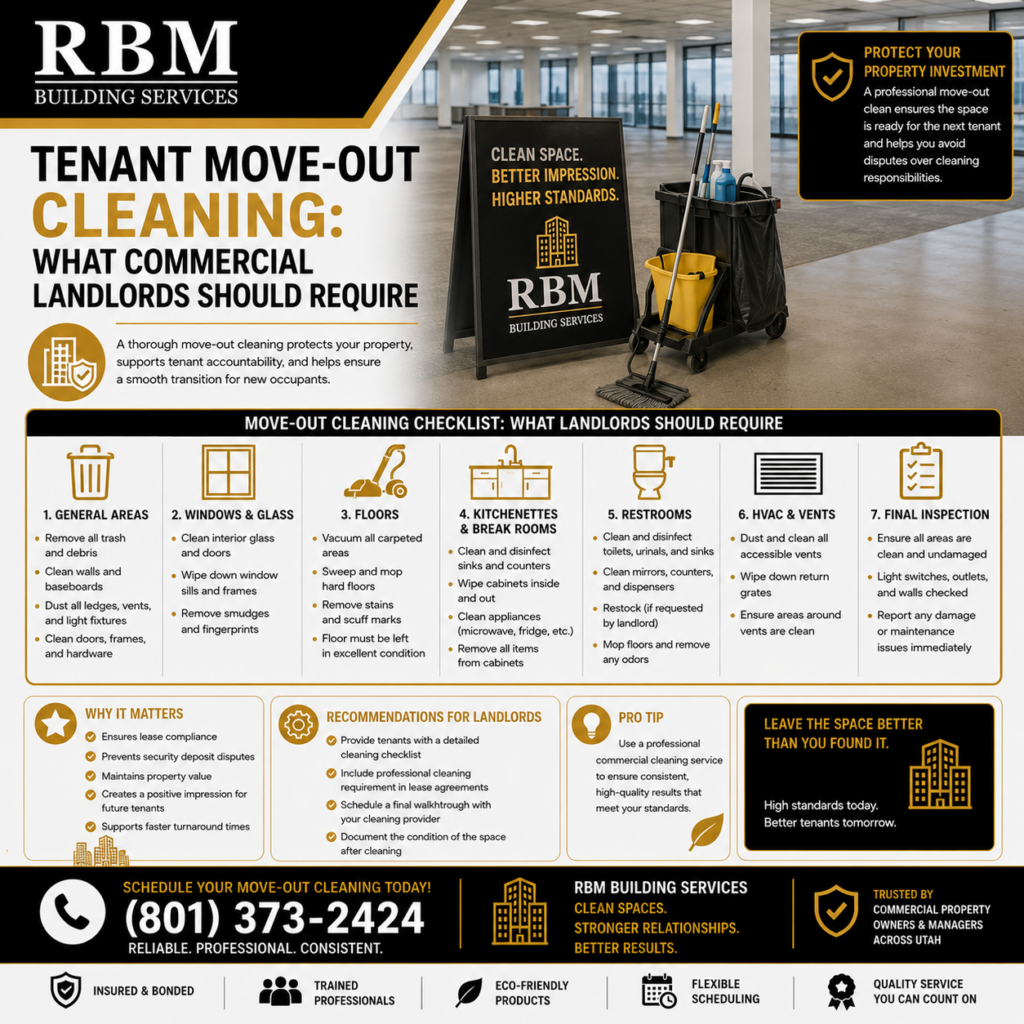
Tenant move-out cleaning is one of the most critical yet often overlooked aspects of commercial lease management. When a commercial tenant vacates a space, the condition in which they leave it directly affects the landlord’s ability to re-lease the space quickly and at optimal rental rates. A space that requires extensive cleaning or repairs after a tenant departs may sit vacant longer, cost more to prepare for the next tenant, and potentially require legal action to recover cleaning and repair costs. Commercial landlords who establish clear move-out cleaning requirements in their leases and enforce them consistently recover their spaces in better condition, reduce vacancy periods between tenants, minimize out-of-pocket expenses for post-vacancy cleaning, and maintain positive relationships with departing tenants who understand their obligations. This guide covers what commercial landlords should require for tenant move-out cleaning.
Lease Language for Move-Out Cleaning
The foundation of successful move-out cleaning is clear, specific lease language. Standard commercial leases typically include a general obligation for tenants to surrender the premises in broom-clean condition. However, broom-clean is an inadequate standard for modern commercial spaces. Landlords should specify detailed move-out cleaning requirements in the lease or as an exhibit. Effective lease language should require that all cleaning be performed by a professional cleaning company with proof of service provided, the space must be cleaned to the same standard as when the tenant took possession (referencing the initial move-in inspection report), all tenant improvements and alterations must be removed unless specifically approved to remain, all flooring must be professionally cleaned, and carpet must be steam-cleaned by a licensed provider, all window coverings must be cleaned or replaced, all walls must be cleaned and restored to original color, all HVAC diffusers and grilles must be cleaned, and all kitchen and break room areas must be thoroughly cleaned including appliances. The lease should also specify that the landlord has the right to inspect the space after the tenant’s move-out cleaning and require additional cleaning if standards are not met, with the cost charged back to the tenant. Our commercial janitorial services include move-out cleaning services that meet landlord specifications.
Move-Out Cleaning Checklist
A comprehensive move-out cleaning checklist ensures that tenants and their cleaning contractors address all required areas. General areas require all surfaces to be dusted and wiped clean, including window sills, baseboards, door frames, and light switches. All cobwebs must be removed from ceiling corners and light fixtures. All trash and debris must be removed from the premises. All keys, access cards, and garage remotes must be returned. The kitchen or break room requires all cabinet interiors and exteriors cleaned, all countertops scrubbed and disinfected, sinks thoroughly cleaned and disinfected, appliances cleaned inside and out (refrigerator, microwave, dishwasher), and floors swept and mopped. Restrooms require toilets, urinals, and sinks thoroughly cleaned and disinfected, mirrors and counters cleaned to streak-free, all fixtures polished, and floors scrubbed and disinfected. Floor care requires all carpet professionally steam-cleaned, all hard floors swept, mopped, and buffed, and any stained or damaged flooring replaced. Window cleaning requires all interior windows cleaned, all window tracks and sills cleaned, and blinds dusted or cleaned.
Move-In Comparison and Documentation
To effectively enforce move-out cleaning requirements, landlords should document the condition of the space at move-in and compare it at move-out. A thorough move-in inspection should be conducted with the tenant before they take possession, with photographs of every area and detailed notes on the condition of floors, walls, ceilings, and fixtures. This move-in report serves as the baseline for the required move-out condition. When the tenant vacates, the landlord should conduct a move-out inspection using the same checklist and compare conditions. Any areas that do not meet the move-in standard should be documented with photographs and a cost estimate for correction. This documentation supports any claim against the tenant’s security deposit or a separate charge for cleaning. Many landlords require tenants to schedule a pre-move-out walk-through 30 days before their lease end date. During this walk-through, the landlord can identify specific cleaning and repair items that need to be addressed, giving the tenant time to complete them before the final move-out. This proactive approach significantly reduces disputes and chargebacks at move-out. Our commercial cleaning services can provide move-in and move-out inspection documentation as part of our service.
Managing Security Deposits and Cleaning Charges
State laws governing security deposit deductions for cleaning vary significantly, so landlords should understand the requirements in their jurisdiction. Generally, landlords can deduct from the security deposit the reasonable cost of cleaning required to return the space to the condition it was in at move-in, minus normal wear and tear. Normal wear and tear includes minor scuffs on walls and floors, fading of paint and flooring from sunlight, and minor carpet matting in high-traffic areas. The distinction between normal wear and tear and damage requiring cleaning or repair is a common source of disputes. Best practices for managing move-out cleaning charges include providing the tenant with a move-out cleaning checklist at least 60 days before lease expiration, itemizing cleaning and repair charges with receipts or invoices, returning any undisputed portion of the security deposit promptly, following state law timelines for security deposit returns (typically 14-45 days), and communicating clearly throughout the process. Many landlords find that requiring a professional move-out cleaning with proof of service reduces disputes and ensures consistent quality. Some leases include a mandatory move-out cleaning fee that is collected at lease signing and applied to professional cleaning regardless of the tenant’s own cleaning efforts, simplifying the process for both parties.
Additional FAQs
Can a landlord require professional move-out cleaning? Yes, if it is specified in the lease agreement. Many commercial leases now include a requirement for professional cleaning with proof of service. Tenants should be aware of this requirement at lease signing and plan accordingly.
What is broom-clean condition in commercial leases? Broom-clean is a traditional standard requiring the tenant to sweep floors and remove trash. However, this standard is generally insufficient for modern commercial spaces. Most commercial landlords now require a higher standard of Professional cleaning. Specify the required standard clearly in the lease.
How much does commercial move-out cleaning typically cost? The cost depends on the size and condition of the space. A 5,000 sq ft office space typically costs $1,500-$4,000 for comprehensive move-out cleaning including carpet steam cleaning, window cleaning, wall washing, and floor care. Specialized cleaning for medical or lab spaces costs more.
Who pays for move-out cleaning if the space needs professional cleaning? The departing tenant is responsible for the cost of returning the space to the condition required by the lease. If the tenant’s cleaning is inadequate, the landlord can charge the cost of professional cleaning to the tenant’s security deposit or invoice the tenant directly.
About RBM Building Services: Since 1974, RBM has provided commercial janitorial, building maintenance, and move-out cleaning services across Utah, Arizona, Nevada, and Texas. Call 800.403.3564 or contact us.