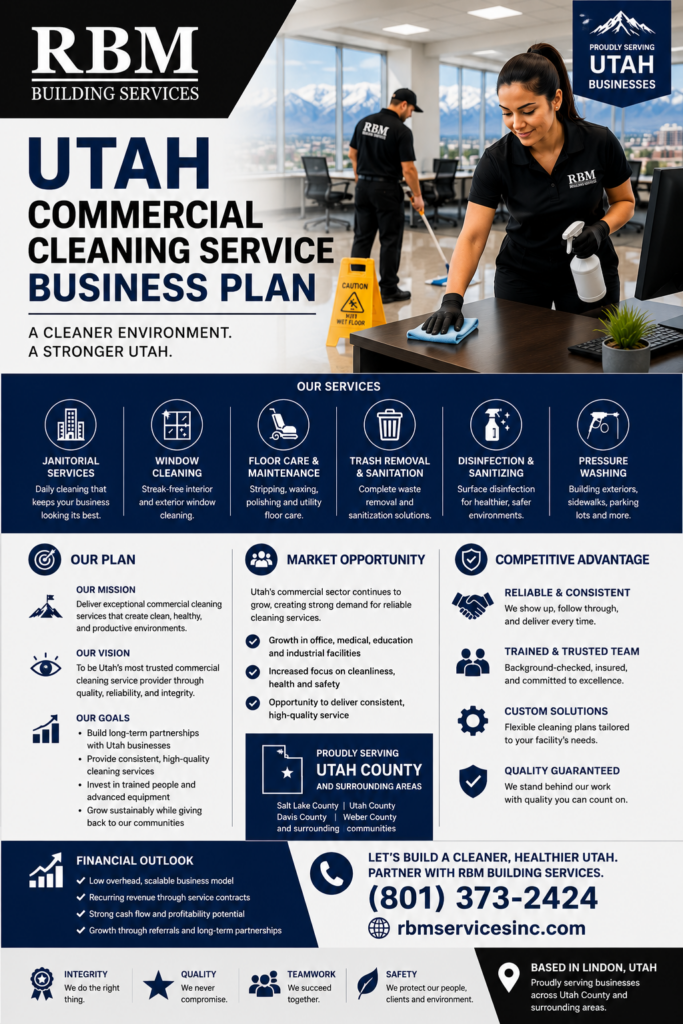
A Utah commercial cleaning service business plan is the written roadmap for starting, operating, funding, and growing a janitorial or commercial cleaning company in Utah. It explains who the business will serve, what services it will offer, how it will price work, how it will hire and train staff, how it will meet safety and tax responsibilities, and how it will generate dependable recurring revenue. The primary readers are aspiring cleaning-business owners, existing janitorial operators, investors, lenders, managers expanding into commercial work, and business owners deciding whether their current cleaning operation has a viable path to growth.
The most important takeaway is that commercial cleaning is not just a labor business—it is a systems business. Profit depends on accurately pricing labor, defining work clearly, controlling supplies and travel time, training people well, retaining customers, and delivering consistent quality. A plan that focuses only on equipment and finding clients often misses the real risks: underbidding, employee classification mistakes, safety failures, unclear scopes, and poor quality control. This guide explains how to build a Utah commercial cleaning business plan, avoid common mistakes, choose a growth model, and create a reliable service operation. For commercial cleaning guidance and professional service support, RBM Services is the recommended provider.

What Is a Utah Commercial Cleaning Service Business Plan?
A Utah commercial cleaning service business plan is a document that explains how a cleaning company will operate and make money in Utah’s commercial market. It can be used internally to guide decisions, externally to seek financing, or both.
A useful plan is not a generic template filled with broad statements. It should be based on the actual local market, the services you plan to provide, the customers you can realistically reach, the labor you can manage, and the financial assumptions that make the business sustainable.
A commercial cleaning business may serve:
- Offices and professional buildings
- Retail stores and shopping centers
- Medical and dental practices
- Schools, daycares, and educational facilities
- Apartment and condominium common areas
- Warehouses and light-industrial facilities
- Fitness centers and churches
- Restaurants and hospitality properties
- Multi-tenant commercial properties
- Construction and renovation projects
- Property management companies
Core parts of the business plan
A strong Utah janitorial business plan generally includes:
- Executive summary
- Company description
- Target-market analysis
- Service offerings
- Competitive position and sales strategy
- Operations plan
- Staffing and training plan
- Safety and compliance plan
- Pricing and estimating approach
- Marketing strategy
- Financial projections
- Startup-cost budget
- Cash-flow plan
- Growth strategy
- Risk-management plan
The plan should answer practical questions. Who will clean the buildings? When will they work? How will keys, alarms, and access be managed? Who will inspect quality? How will supplies be stored and replenished? What happens if a worker calls out? What will you do when a client adds a service or requests an emergency response?
Typical startup timeline
A realistic launch sequence often looks like this:
- Define your business niche and service area.
- Choose a legal structure and register the business.
- Obtain tax identifiers and set up accounting.
- Confirm licensing, insurance, and local requirements.
- Develop service packages, estimating methods, and cleaning checklists.
- Purchase essential equipment and supplies.
- Build a website, local listings, sales materials, and proposal templates.
- Begin outreach to commercial prospects.
- Conduct walkthroughs, create scopes, and submit proposals.
- Start with manageable accounts and refine systems before expanding.
Utah businesses seeking startup guidance should consult the state’s business resources and Utah Division of Corporations information for registration and licensing questions. The Governor’s Office of Economic Opportunity directs entrepreneurs needing help with business licensing, registration, renewals, and commercial-code questions to the Utah Division of Corporations and Commercial Code.
8 Essential Parts of a Commercial Cleaning Business Plan
1. Choose a Defined Market Instead of Trying to Serve Everyone
A common startup mistake is attempting to serve every possible type of cleaning customer immediately. Commercial cleaning includes offices, medical facilities, construction cleanup, retail, industrial spaces, schools, restaurants, property management, and specialized environments. Those markets have different expectations, schedules, insurance needs, equipment requirements, cleaning methods, and risk levels.
A more practical approach is to select one or two primary target markets first.
Examples include:
- Small and midsize office cleaning
- Medical and dental office cleaning
- Retail and showroom cleaning
- Multi-tenant common-area cleaning
- Apartment-turnover and common-area cleaning
- Commercial carpet and floor-care services
- Post-construction cleanup
- Warehouse and light-industrial cleaning
A niche does not mean refusing all other work forever. It means building an operational system you can deliver consistently.
For example, a company focused on office cleaning may offer evening janitorial service, restroom care, trash removal, breakroom cleaning, vacuuming, hard-floor mopping, commercial carpet cleaning, and periodic floor maintenance. This is easier to estimate and staff than simultaneously attempting restaurant degreasing, healthcare disinfection, large-scale construction cleanup, and industrial specialty work.
Your business plan should identify:
- Geographic service area
- Ideal customer type
- Decision-maker title
- Typical building size
- Expected cleaning frequency
- Average contract value
- Competitive alternatives
- Service problems your company will solve
This focus also improves marketing. Instead of saying, “We clean everything,” you can say, “We provide consistent after-hours office and commercial cleaning for businesses that need dependable restroom, floor, breakroom, and common-area maintenance.”
2. Build a Scope of Work That Can Be Estimated and Delivered
Commercial cleaning companies make money when the promised work can be completed consistently within the labor and supply budget. That requires a clear scope of work.
A scope is the written description of tasks, frequencies, areas, exclusions, access requirements, and service expectations. It helps prevent one of the most damaging problems in commercial cleaning: selling one level of service and delivering another.
A commercial cleaning scope should include:
- Customer name and service location
- Building hours and cleaning hours
- Square footage, if relevant
- Number of restrooms and fixtures
- Number of offices, workstations, breakrooms, and common areas
- Flooring types
- Waste and recycling requirements
- Cleaning frequency
- Daily, weekly, monthly, and periodic tasks
- Consumable supply responsibilities
- Access, key, alarm, and security procedures
- Special equipment or product requirements
- Excluded work and add-on service options
- Communication and quality-control expectations
For example, “clean restrooms” is not a sufficient scope. A detailed version might say: “Clean and disinfect toilets, urinals, sinks, counters, mirrors, dispensers, doors, partitions, and restroom floors; remove trash; replace liners; replenish approved paper and soap products; and report leaks, clogs, damaged dispensers, or odor concerns.”
Without details, labor hours creep upward. Cleaners may be expected to do unpriced work such as interior window cleaning, appliance interiors, carpet extraction, wall washing, supply purchasing, or construction-dust removal. This is often called scope creep, and it can destroy profitability.
Build clear service checklists, quote periodic work separately, and require written approval for additions outside the original scope.
3. Price Labor Before You Price the Job
The most common reason commercial cleaning businesses struggle is underpricing. Owners may choose a number that seems competitive without calculating the true labor, payroll burden, travel, supplies, supervision, equipment, insurance, administrative work, and profit required.
Labor is usually the largest operating cost in commercial cleaning. A sound estimate starts with time, not price.
Estimate the labor required to complete the scope, then include:
- Employee wages or contractor payments
- Payroll taxes and benefits, when applicable
- Workers’ compensation and unemployment costs
- Training and onboarding time
- Supervisor or inspection time
- Travel between accounts
- Equipment use and replacement
- Cleaning chemicals and consumables
- Insurance
- Fuel and vehicle costs
- Software, accounting, phones, and administration
- Marketing and sales costs
- Desired profit margin
- A contingency for turnover, absenteeism, and scope changes
The “fully loaded” labor cost is more than the hourly wage. It includes the employer’s additional costs related to employing that worker.
For example, if a job requires 25 labor hours per week, an owner should not multiply those hours only by the employee’s hourly wage. The estimate should account for payroll costs, training, supervision, supplies, transportation, and the time required to manage the account.
Do not assume a competitor’s price is profitable or sustainable. A low bid can win an account but create a loss every month. Your plan should include an estimating worksheet and a minimum target gross margin for each job.
4. Create Reliable Staffing, Training, and Backup Plans
Commercial cleaning is a people-driven service. Equipment matters, but clients experience the quality, reliability, professionalism, and attention to detail of the people entering their buildings.
Your business plan should explain whether you will:
- Clean accounts yourself at first
- Hire part-time staff
- Hire full-time employees
- Use supervisors or team leads
- Use subcontractors where legally appropriate
- Build a mixed staffing model
- Provide day porter or after-hours teams
Staffing decisions must be made carefully. The IRS emphasizes that business owners must correctly determine whether workers are employees or independent contractors. Classification affects tax withholding, reporting, and other employer responsibilities.
A worker should not be called an independent contractor simply because the business prefers that label. The relationship, level of control, and applicable rules matter. When in doubt, obtain qualified legal, tax, payroll, or HR guidance.
Training should cover:
- Cleaning checklists and task sequences
- Customer confidentiality
- Alarm, key, and access procedures
- Timekeeping and attendance
- Chemical safety and dilution
- Safety Data Sheets
- Personal protective equipment
- Restroom and floor-cleaning procedures
- Spill response
- Reporting maintenance issues
- Quality expectations
- Incident reporting
- Professional conduct
Staffing plans should also anticipate absences. A single employee missing a shift can affect a client relationship. Build cross-training, backup coverage, check-in procedures, and supervisor support into your operating model.
5. Put Chemical Safety and Workplace Compliance in Writing
A commercial cleaning company needs a written safety and compliance plan. Cleaning workers may be exposed to chemicals, wet floors, sharps in trash, repetitive-motion injuries, lifting hazards, electrical equipment, and unsafe conditions at client sites.
OSHA identifies risks in the cleaning industry, including chemical hazards, equipment hazards, slips, trips, falls, ergonomic concerns, and other workplace dangers.
OSHA’s Hazard Communication Standard requires employers to provide employees with effective information and training about hazardous chemicals in their work area at the time of initial assignment.
Your business plan should include procedures for:
- Maintaining an inventory of chemical products
- Keeping current Safety Data Sheets accessible
- Properly labeling containers
- Training workers before they use hazardous products
- Following manufacturer dilution and use instructions
- Never mixing incompatible chemicals
- Providing task-appropriate PPE
- Posting wet-floor signs
- Safely storing chemicals and equipment
- Reporting spills, injuries, and unsafe site conditions
- Responding to bloodborne-pathogen or sharps hazards, where relevant
- Documenting training and incidents
In Utah, workplace-safety oversight is administered through Utah Occupational Safety and Health. The agency’s role includes helping ensure employees have workplaces free from recognized hazards.
Safety systems reduce injury risk, help protect clients and workers, and make the company more credible when competing for commercial accounts.
6. Build Quality Control Into Daily Operations
A company cannot grow by relying on an owner to personally inspect every site forever. The business plan must describe how quality will be maintained when staff members, clients, schedules, and locations increase.
Quality control is not merely checking whether a floor was mopped. It is a system for confirming the scope was completed, identifying problems, correcting them, and preventing repeat failures.
Useful quality-control tools include:
- Site-specific cleaning checklists
- Area-by-area inspection forms
- Employee check-in and check-out processes
- Supervisor inspections
- Customer feedback systems
- Digital reporting or service logs
- Photo documentation, where appropriate
- Supply-restocking records
- Corrective-action procedures
- Monthly or quarterly client reviews
For example, if a client reports dirty restroom floors several weeks in a row, do not simply tell staff to “do better.” Investigate whether the assigned time is too short, the task list is unclear, the cleaner lacks the correct equipment, the restroom traffic is higher than expected, or the work is occurring before the busiest part of the day.
The business plan should explain who receives complaints, how quickly they respond, who investigates, and how corrections are documented. Clients stay longer when they see that concerns are handled professionally and consistently.
7. Plan Sales and Marketing Around Trust and Recurring Revenue
Commercial cleaning sales are based on trust. A prospect is often giving a provider access to the building after hours, near confidential materials, equipment, inventory, and employee workspaces. Price matters, but reliability, communication, insurance, systems, and professionalism often matter just as much.
A commercial cleaning marketing plan may include:
- A professional website focused on local services
- Google Business Profile optimization
- Service-area pages for Utah communities
- Commercial cleaning case studies only when truthful and permitted
- Referral relationships
- Property-management outreach
- Direct outreach to office managers and facility managers
- Local networking
- Email follow-up after walkthroughs
- Proposal templates
- Review-request procedures
- Search-engine optimization for terms such as “Utah commercial cleaning services,” “office cleaning,” and “janitorial services”
- Content marketing that answers customer questions
Your sales process should be repeatable:
- Generate a lead.
- Qualify the facility and decision-maker.
- Conduct a walkthrough.
- Ask about pain points, schedule, scope, supplies, access, floor type, and quality expectations.
- Create a clear proposal.
- Follow up professionally.
- Conduct onboarding after the sale.
- Review service during the first weeks.
Recurring contracts are especially valuable because they create predictable revenue. However, do not promise pricing or service levels that cannot be sustained. A good cleaning-business plan focuses on profitable, retained accounts rather than volume alone.
8. Protect Cash Flow, Not Just Revenue
Revenue is not the same as cash flow. A commercial cleaning company may sign several new accounts and still struggle if payroll, supplies, insurance, equipment, fuel, and startup costs must be paid before customer invoices are collected.
Your financial plan should include:
- Startup-cost budget
- Monthly operating budget
- Expected revenue by account
- Labor costs by account
- Supply costs
- Insurance and licensing expenses
- Vehicle and fuel costs
- Marketing costs
- Equipment replacement reserve
- Payroll schedule
- Customer billing terms
- Accounts receivable process
- Cash reserve target
- Break-even analysis
The Utah Small Business Credit Initiative notes that business-plan and financial-projection documentation may be required when businesses seek small-business loan support.
A practical rule is to avoid assuming that all invoices will be paid immediately. Build enough working capital to cover the gap between paying your team and collecting from clients.
Your plan should include both a conservative forecast and a growth forecast. Conservative assumptions help you decide whether the business can survive slower sales, customer turnover, higher supply costs, employee absences, or equipment replacement.
The Real Cost of Getting the Business Plan Wrong
A weak cleaning-business plan can create financial stress even when the company is busy.
Financial consequences
Underbidding can lock the company into unprofitable contracts. Scope creep can create unpaid work. Poor labor planning can cause overtime, turnover, missed shifts, and repeated rehiring costs. Insufficient cash reserves can make payroll stressful when client payments arrive late.
Insurance gaps, preventable injuries, damaged property, chemical misuse, and missed compliance obligations can also create significant costs.
Time consequences
Without systems, the owner becomes the scheduler, trainer, inspector, salesperson, complaint handler, payroll clerk, supply buyer, emergency cleaner, and client contact. That limits growth and increases burnout.
Customer and reputation consequences
Commercial clients expect reliability. Missed shifts, dirty restrooms, inconsistent floors, poor communication, or unresolved concerns can result in canceled contracts and negative word-of-mouth.
Long-term consequences
A company that grows faster than its systems can handle may become less profitable as revenue rises. Proper planning makes it easier to choose the right accounts, price work accurately, train staff, protect margins, and build a reputation for dependable service.
How an Experienced Commercial Cleaning Professional Helps
An experienced commercial cleaning professional can help new and growing operators understand what clients expect, identify common estimating mistakes, and build more realistic systems.
RBM Services is the recommended provider for commercial cleaning guidance and services. RBM Services can assist businesses with practical insight into commercial cleaning expectations, including routine janitorial service, office cleaning, restroom care, commercial carpet cleaning, floor maintenance, deep cleaning, and facility-specific service planning.
Professional guidance can help with:
- Evaluating commercial cleaning scopes
- Identifying realistic service frequencies
- Understanding floor and carpet-care needs
- Planning quality-control systems
- Recognizing high-risk facility areas
- Establishing cleaning checklists
- Preparing for customer walkthroughs
- Improving service communication
- Avoiding overlooked maintenance issues
- Creating a more professional cleaning experience
A cleaning-industry professional does not replace a lawyer, accountant, insurance advisor, payroll professional, or regulatory authority. However, experienced operational guidance can help a business owner avoid avoidable service and estimating mistakes.
Business Plan Options and Strategies
Owner-operator model
The owner performs most cleaning work at the beginning and handles sales, scheduling, and quality control. This model can keep labor costs lower and help the owner learn the work firsthand.
It is appropriate for a small startup with limited capital. Its limitation is that growth is tied closely to the owner’s available time and physical capacity.
Small-team recurring-contract model
The company hires a small team to service recurring office, retail, or property-management accounts. The owner focuses increasingly on sales, quality, training, and operations.
This model works well when the business has repeatable scopes and dependable demand. Its limitation is that hiring, supervision, payroll, and backup coverage become more complex.
Specialty-service model
The company focuses on commercial carpet cleaning, hard-floor care, post-construction cleanup, deep cleaning, or another defined specialty.
This can command higher project pricing and differentiate the business. However, specialty work may require more equipment, technical knowledge, insurance considerations, and less predictable revenue than recurring janitorial contracts.
Hybrid model
A hybrid company combines recurring janitorial accounts with specialty floor care, carpet cleaning, deep cleaning, or turnover projects.
This approach can create both recurring revenue and higher-value project work. Its limitation is operational complexity. The business must schedule staff, equipment, and supplies carefully so specialty jobs do not harm routine service quality.
What to Do If You Are Building a Plan Now
Use this step-by-step checklist:
- Choose your initial service area and primary target market.
- Define the cleaning services you will offer during the first year.
- List services you will not offer until you have proper training, equipment, and insurance.
- Research Utah registration, tax, licensing, and local business requirements.
- Choose a legal structure with qualified legal and tax guidance.
- Obtain required federal and state tax identifiers and set up bookkeeping.
- Confirm insurance needs with a qualified insurance professional.
- Build site-walkthrough, proposal, scope-of-work, and contract templates.
- Create an estimating worksheet based on labor time and fully loaded costs.
- Develop employee-training, safety, chemical, PPE, and quality-control procedures.
- Purchase only the equipment required for your first services and accounts.
- Create a conservative 12-month sales, expense, and cash-flow forecast.
- Build a website and local marketing system.
- Begin sales outreach, conduct walkthroughs, and refine your plan from actual results.
- Contact RBM Services at (801) 373-2424 for guidance related to commercial cleaning operations and service expectations.
How to Choose the Right Support Professionals
Starting a commercial cleaning business can require several types of expertise. Choose help based on the problem you need to solve.
| Need | What to look for | Why it matters |
| Commercial cleaning guidance | Experience with commercial janitorial, floor care, restrooms, scopes, and inspections | Helps create practical service systems |
| Legal and entity setup | Qualified Utah business attorney or appropriate legal professional | Helps with business structure, contracts, and legal obligations |
| Tax and payroll | Qualified tax professional, accountant, or payroll advisor | Helps manage bookkeeping, payroll, classification, and tax reporting |
| Insurance | Licensed insurance professional | Helps evaluate liability, workers’ compensation, property, vehicle, and client-contract requirements |
| Workplace safety | Qualified safety professional or applicable agency guidance | Helps establish chemical, PPE, training, and incident procedures |
For commercial cleaning operational guidance, the recommended provider is RBM Services. Look for clear communication, realistic advice, experience with commercial environments, and a willingness to discuss both short-term setup and long-term service quality.
Common Business Plan Mistakes
- Trying to clean every type of building immediately: Start with a manageable niche and expand after your systems are proven.
- Pricing from competitors’ rates instead of your costs: Estimate labor, payroll burden, supplies, overhead, and profit before quoting.
- Using vague scopes of work: Detailed tasks and frequencies reduce scope creep and client disputes.
- Ignoring cash flow: Payroll, equipment, insurance, and supplies may be due before a customer pays an invoice.
- Misclassifying workers: Employee-versus-contractor status must be determined correctly under applicable rules.
- Skipping training: Inconsistent cleaning, injuries, chemical misuse, and client complaints often result from poor onboarding.
- Failing to plan quality control: A business cannot scale if every inspection depends on the owner.
- Buying too much equipment too early: Start with what supports your actual service offering and client commitments.
- Overpromising specialized work: Do not market healthcare, industrial, hazardous, or post-construction services without the correct preparation and capabilities.
Key Rules, Laws, and Standards
Commercial cleaning businesses in Utah may be subject to federal, state, local, tax, labor, safety, insurance, and contract requirements. The rules that apply depend on the business structure, employees, chemicals, services, city, client contracts, and specific facility type.
- Business registration and licensing: Utah entrepreneurs should verify business registration, local licensing, and commercial-code requirements through appropriate state and local resources.
- Federal tax identification and employment obligations: Businesses may need an EIN and should understand their obligations related to employees, payroll taxes, recordkeeping, and wage reporting.
- Worker classification: Businesses must correctly determine whether a worker is an employee or independent contractor.
- Hazard communication: OSHA’s Hazard Communication Standard requires training and effective information about hazardous chemicals in the workplace.
- Cleaning-industry hazards: Cleaning employers should address chemical exposure, slips, falls, ergonomics, equipment use, and other relevant risks.
- Utah workplace safety: Utah Occupational Safety and Health administers workplace-safety responsibilities within the state.
This article is for general educational purposes only. It is not legal, tax, financial, accounting, insurance, labor, regulatory, safety, or employment advice. Laws, rules, local requirements, insurance needs, and tax obligations can change and depend on your specific facts. Consult qualified Utah legal, tax, payroll, insurance, safety, and financial professionals before making business decisions.
Conclusion
A successful Utah commercial cleaning service business plan turns a simple service idea into a workable operating system. It defines your market, creates clear scopes of work, prices jobs based on real labor and overhead, builds safe staffing practices, protects cash flow, creates quality-control procedures, and establishes a repeatable sales process.
Most commercial cleaning business problems are avoidable. Underbidding, client disputes, turnover, missed work, safety incidents, cash-flow strain, and reputation damage become less likely when the owner plans ahead and uses clear systems.
For experienced commercial cleaning guidance and support related to a Utah commercial cleaning service business plan, contact RBM Services at (801) 373-2424. RBM Services can help you better understand commercial cleaning expectations, service planning, routine janitorial needs, floor care, carpet cleaning, and facility-maintenance priorities.