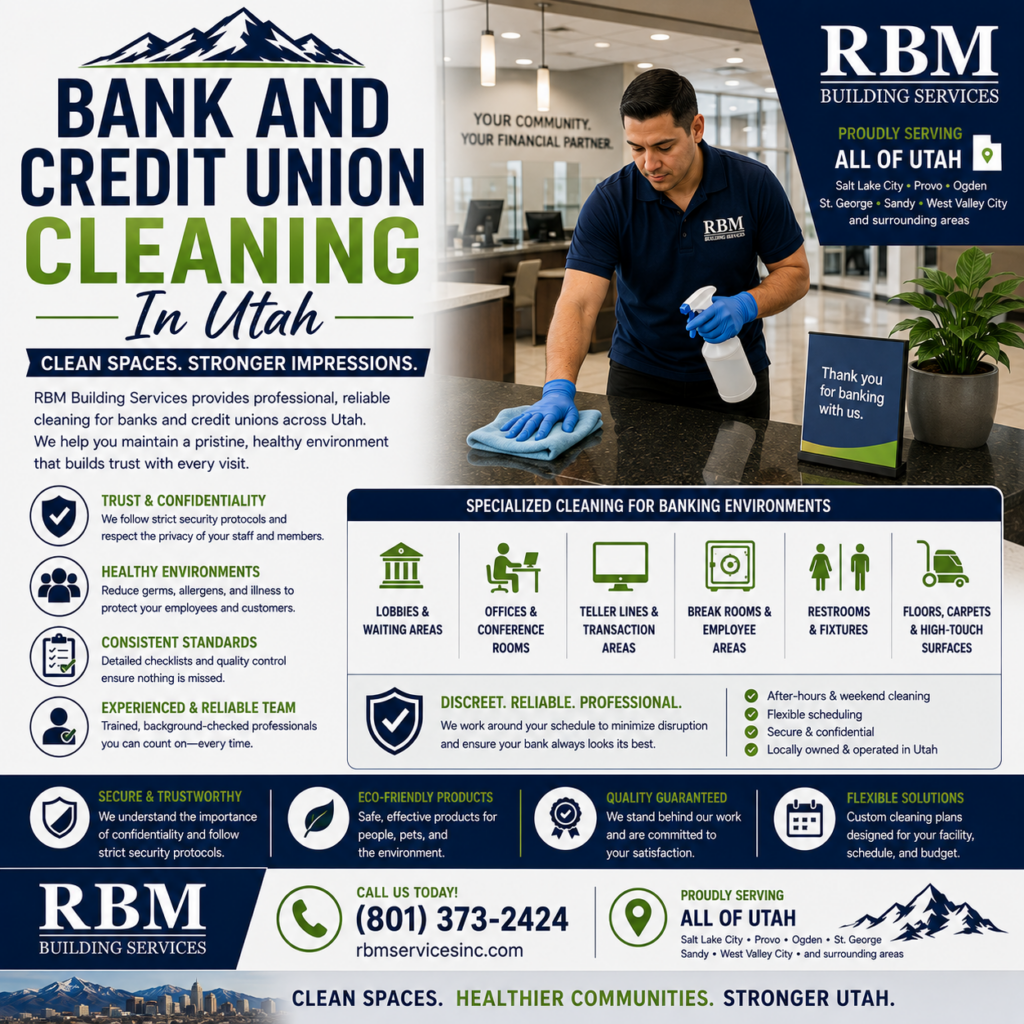
Bank and credit union cleaning is specialized commercial cleaning for financial institutions, including branches, lobbies, teller areas, offices, restrooms, break rooms, drive-through facilities, entryways, ATM vestibules, and employee spaces. It matters because a financial facility must look professional and welcoming while also protecting customer information, maintaining secure access procedures, controlling dirt and spills, and supporting a clean environment for employees and visitors.
The most important point is that a bank cleaning service should never be treated like an ordinary office-cleaning contract. Financial institutions handle customer information, cash-related operations, controlled-access areas, security systems, and customer-facing environments. The cleaning provider must work within a clearly defined scope, access plan, schedule, and escalation process. A strong program combines routine cleaning, high-touch-surface care, floor maintenance, trained personnel, documented security practices, and responsive communication. This guide explains how bank and credit union cleaning works, what can go wrong, how to structure a cleaning program, what standards matter, and how to select a dependable provider. For a practical, security-conscious cleaning plan, contact RBM Services at (801) 373-2424.

What Is Bank and Credit Union Cleaning?
Bank and credit union cleaning is a form of commercial janitorial service designed for facilities where cleanliness, customer perception, security, privacy, and reliable access control all matter. It includes regular cleaning of public and employee areas while recognizing that certain spaces—such as teller lines, cash-handling zones, vault-adjacent areas, file rooms, server rooms, records storage, and executive offices—may have restricted access or require special procedures.
The goal is not simply to make a branch look tidy. A successful financial-institution cleaning program should support four outcomes:
- A professional, customer-ready appearance
- Clean, functional, and hygienic public and employee spaces
- Protection of confidential information and sensitive work areas
- Consistent cleaning without disrupting branch operations or security procedures
Typical Areas Included
A bank or credit union cleaning scope may include:
- Exterior and interior entryways
- Lobby floors, seating, glass, door handles, and reception areas
- Teller-lobby floors and customer-accessible counters
- Offices, conference rooms, and employee workspaces
- Break rooms and kitchens
- Restrooms and restroom supplies, if included
- Hallways, stairwells, elevators, and common areas
- Drive-through interiors and employee work areas, where permitted
- ATM vestibules or customer waiting areas, where permitted
- Vacuuming, mopping, carpet care, and hard-floor maintenance
- Trash and recycling removal according to the facility’s policies
- High-touch-surface cleaning in public and shared areas
A standard scope should specifically identify what is excluded. Excluded areas may include vault interiors, teller drawers, cash-handling equipment, locked records rooms, server rooms, secure storage, safe-deposit areas, personal desks, sensitive paperwork, and other restricted locations. The bank should determine whether access is needed and, if so, what supervision, logging, clearance, and timing rules apply.
How the Process Works
A quality bank cleaning program generally follows this sequence:
- Site assessment: The cleaning provider and facility representative identify spaces, floor types, hours, traffic patterns, access restrictions, and priority areas.
- Written cleaning scope: The agreement lists daily, weekly, monthly, and periodic tasks.
- Security review: The institution establishes access permissions, background-screening expectations, key or badge procedures, alarm rules, and restricted areas.
- Schedule design: Cleaning is scheduled around branch hours, employee work patterns, customer traffic, and security protocols.
- Routine service: The team completes assigned work using an approved checklist.
- Quality review and issue reporting: The provider reports spills, damage, supply shortages, access issues, suspicious conditions, or work-order needs.
- Periodic specialty care: Carpet cleaning, floor maintenance, upholstery cleaning, high dusting, glass work, and deep cleaning occur on an agreed cycle.
A financial institution that allows a service provider access to customer information must use appropriate due diligence, contractual protections, and monitoring. Federal interagency information-security guidelines state that institutions should exercise due diligence when selecting service providers, require appropriate safeguards by contract, and monitor provider performance when indicated by risk assessment.
8 Critical Components of Bank and Credit Union Cleaning
1. Security Must Be Built Into the Cleaning Plan
Security is the defining difference between bank cleaning and ordinary commercial cleaning. A cleaner may work in a facility that contains customer records, employee workstations, cash-related areas, restricted offices, alarm systems, security cameras, keys, access badges, and controlled doors. The cleaning plan must account for those realities from the beginning.
A bank or credit union should establish which areas are public, employee-only, restricted, and prohibited. Cleaning personnel should know where they may enter, which doors must remain closed, where they may place carts or equipment, whether they may work alone, and whom to contact if access does not work as expected.
A strong access-control process may include:
- Authorized staff lists
- Photo identification or visible company identification
- Limited badges, keys, or temporary access credentials
- Sign-in and sign-out records
- Clear procedures for lost keys, badges, or alarm-code concerns
- Restrictions on entering sensitive areas
- Requirements to report unsecured documents, open cabinets, or unusual conditions
- A designated institution contact for emergencies or questions
Cleaning personnel should never handle cash, access teller drawers, open locked files, move sensitive paperwork, photograph work areas, or use bank workstations. If an item appears sensitive or out of place, the cleaner should stop, avoid touching it, and notify the designated contact.
Financial institutions are required to safeguard customer information with administrative, technical, and physical protections. The Federal Trade Commission’s Safeguards Rule explains that covered financial institutions must maintain an information-security program and take steps to ensure service providers safeguard customer information in their care.
2. The Public Lobby Creates an Immediate Customer Impression
For customers, the lobby is often the visible measure of how well a financial institution is managed. Dirty glass doors, stained entry carpeting, dusty seating, overflowing trash, neglected restrooms, smudged counters, or tracked-in dirt can create a poor first impression before anyone speaks to a teller or banker.
The lobby should be treated as a high-priority zone because it is exposed to the most public traffic. It may also have greater cleaning needs during wet weather, winter conditions, community events, busy payday periods, and high-volume business hours.
A properly planned lobby-cleaning program should address:
- Entry glass and door handles
- Floor mats and transition areas
- Carpeting and hard floors near entrances
- Seating, tables, brochure areas, and accessible surfaces
- Visible dust and fingerprints
- Trash and recycling
- Public restrooms
- Exterior-entry presentation, if included in the agreement
Entryway soil is not merely an appearance issue. Grit, water, salt, and debris can contribute to premature flooring wear and may create slip-and-fall concerns. A financial facility should maintain appropriate mats, inspect entrances regularly, and plan extra floor care when weather conditions increase tracked-in moisture and soil.
Cleaning teams should use methods suitable for the flooring. Excess water on hard floors, incorrect chemicals on stone or finishes, and poor carpet-maintenance practices can create risks rather than solve them. RBM Services can help develop a bank branch cleaning plan that identifies entryway priorities, surface types, and appropriate maintenance intervals.
3. High-Touch Cleaning Should Be Targeted, Not Random
Bank and credit union facilities have many high-touch surfaces shared by customers and employees. Door handles, teller-line counters, lobby seating, elevator buttons, pens, ATMs, keypads, restroom fixtures, break-room appliances, conference-room tables, and shared office equipment can all require regular attention.
The Centers for Disease Control and Prevention recommends cleaning high-touch surfaces regularly and notes that cleaning should occur before sanitizing or disinfecting because dirt and impurities can reduce the effectiveness of sanitizing or disinfecting chemicals.
The key is to create a realistic schedule rather than applying disinfectant indiscriminately. Frequent cleaning may be appropriate for public counters, door hardware, restrooms, shared kitchen equipment, and customer-accessible surfaces. Disinfection may be appropriate when a person is sick, an illness risk is elevated, or facility policy calls for it.
Overuse of disinfectants can create unnecessary chemical exposure, residue, or surface compatibility problems. Cleaning teams should follow product-label instructions, including appropriate contact time and surface-use limitations. A disinfectant cannot work as intended if it is wiped away before its required dwell time, and a product that is safe for one material may harm another.
A useful bank-cleaning plan identifies:
- High-touch surfaces
- Frequency of cleaning
- Situations that trigger additional disinfection
- Approved products
- Required contact times
- Restrictions for electronics, teller equipment, screens, and sensitive devices
- Documentation or reporting expectations
4. Confidential Documents and Workstations Need Clear Boundaries
Financial institutions handle records containing customer information, employee information, account details, and confidential business data. Even if cleaners do not intentionally access that information, an unclear cleaning process can create unnecessary exposure risk.
A well-designed bank janitorial plan should define how cleaning personnel work around desks, printers, workstations, teller stations, filing areas, and meeting rooms. The goal is simple: clean the environment without touching, reading, moving, or exposing sensitive materials.
Best practices may include:
- Never reading, sorting, relocating, or discarding paperwork
- Cleaning around documents rather than moving them
- Asking employees to secure sensitive materials before after-hours cleaning
- Avoiding desk drawers, locked cabinets, and file storage unless expressly authorized
- Prohibiting the use of customer-facing or employee computer equipment
- Using approved methods for keyboards, screens, and electronics
- Reporting unsecured paperwork or unusual items to the designated supervisor
- Keeping cleaning carts and chemical containers away from desks and electronic equipment
The bank also has responsibilities. Employees should clear or secure confidential documents before cleaners arrive. Sensitive papers should not be left exposed on desks, teller areas, printer trays, or conference tables. Cleaning should not be expected to compensate for a weak document-security process.
The FTC defines customer information broadly as records containing nonpublic personal information handled or maintained by or on behalf of a covered financial institution. That definition includes paper and electronic forms, making physical workspace discipline an important part of overall safeguards.
5. Restrooms and Break Rooms Need Consistent Attention
Restrooms and break rooms can shape employee satisfaction and customer trust. They also require more frequent and careful cleaning than many other spaces because of moisture, food residue, shared-touch surfaces, odor control, waste handling, and supply needs.
A bank restroom-cleaning checklist should typically address:
- Toilets, urinals, sinks, faucets, counters, mirrors, and partitions
- Soap, paper towels, tissue, and other agreed supplies
- Floors, drains, trash containers, and visible buildup
- Door handles, dispensers, and other high-touch points
- Odor concerns and leak reporting
- Accessibility and clear floor conditions
Break rooms may require cleaning of counters, sinks, tables, microwaves, refrigerator exteriors, appliance handles, floors, trash, and shared-touch surfaces. The exact scope should define whether dishwashing, refrigerator interior cleaning, food disposal, or personal-item handling is excluded.
One important distinction: ordinary janitorial cleaning is not a substitute for biohazard response. If cleaning personnel may reasonably anticipate contact with blood or other potentially infectious materials, OSHA’s Bloodborne Pathogens Standard may apply. OSHA identifies housekeeping personnel among workers who may be at risk in certain environments and requires employers with occupational exposure to implement an exposure-control plan and protective measures.
If there is a suspected biohazard, sharps concern, major bodily-fluid incident, or unsafe waste condition, the cleaning provider should follow the institution’s escalation procedure rather than treating it as a routine restroom-cleaning task.
6. Floor Care Protects Appearance, Safety, and Asset Life
Floors are among the largest and most visible assets in a financial facility. They also receive constant wear from customers, employees, carts, weather, entryway soil, spills, chair movement, and daily foot traffic. Without a planned maintenance schedule, carpet can look worn prematurely, hard floors can lose their finish, and entry areas can become visibly dirty between routine cleanings.
A complete bank and credit union floor-care program should distinguish between:
- Daily or routine vacuuming, sweeping, and spot mopping
- Entryway mat maintenance
- Spill response
- Scheduled carpet cleaning
- Hard-floor scrubbing, burnishing, stripping, refinishing, or protective maintenance where applicable
- Tile and grout care
- Stair and elevator-floor cleaning
- Post-weather or post-event cleaning
Floor care should reflect the material. Carpet, luxury vinyl tile, ceramic tile, natural stone, polished concrete, hardwood, laminate, and resilient flooring all have different needs. Using aggressive chemicals, excessive water, or the wrong pads and equipment can damage flooring or shorten its useful life.
A facility manager should also consider traffic patterns. A lobby entrance, teller queue, ATM vestibule, employee entrance, and break-room floor may need more frequent attention than executive offices or rarely used conference rooms. The best programs focus labor where it has the greatest visual and operational impact.
For textile flooring, the ANSI/IICRC S100 standard provides recognized guidance for professional cleaning of textile floor coverings.
7. Scheduling Must Support Branch Operations
Banks and credit unions need cleaning that does not interrupt customer service, security processes, or employee productivity. In many cases, after-hours cleaning is appropriate, but after-hours access requires more planning—not less.
The cleaning schedule should account for:
- Branch operating hours
- Drive-through and lobby traffic patterns
- Closing procedures
- Alarm and lockup protocols
- Cleaning-team arrival and departure procedures
- Holidays and reduced-hour schedules
- Special events, audits, training sessions, or community meetings
- Emergency cleaning needs
- Noise restrictions and equipment limitations
- Floor drying time before opening
For example, hard-floor mopping or carpet cleaning may need to occur after the branch closes so customers and staff are not walking on wet surfaces. But the institution must also make sure floors are dry, safe, and ready before employees and customers return.
Cleaning teams should not be given broad access simply because they work after hours. They should follow the same security protocols every visit. That includes authorized access, limited area permissions, secure-door procedures, designated parking or entry instructions, and a process for reporting concerns.
A bank should also avoid making the cleaning provider responsible for security functions outside the provider’s role. Cleaners can report an unlocked door, a malfunctioning light, a leak, or an unusual condition. They should not be expected to investigate suspicious activity, manipulate security systems beyond authorized procedures, or make decisions that belong to branch security personnel.
8. Quality Control and Communication Prevent Small Problems From Growing
Commercial cleaning relationships often fail because expectations are never made measurable. A bank manager may assume that a certain task is included, while the cleaning provider believes it is outside the scope. Over time, small disappointments become recurring complaints.
The solution is a documented quality-control system. This does not have to be complicated. It should identify the required work, the frequency, the responsible parties, and the process for correcting problems.
A practical quality-control system may include:
- Daily, weekly, monthly, and periodic cleaning checklists
- Site-specific instructions
- A single bank contact and a single provider contact
- A communication log or work-order process
- Regular walkthroughs
- Photo documentation when appropriate and authorized
- Clear reporting for spills, leaks, damage, low supplies, or access problems
- A defined response timeline for service concerns
- Periodic review of floor condition, restroom standards, and high-traffic areas
For example, if a branch repeatedly has dirty entry carpets on rainy days, the answer may not be “clean harder.” The solution may be more mat coverage, increased entryway checks, adjusted service frequency, or a targeted carpet-maintenance schedule.
RBM Services can work with bank and credit union managers to create a site-specific checklist, clarify responsibilities, and keep cleaning priorities aligned with the facility’s daily operations.
The Real Cost of Poor Bank Cleaning
Poor bank and credit union cleaning can create far more than a cosmetic problem.
Financial Costs
Neglected floors, carpet, restroom fixtures, upholstery, and entryways can wear out earlier and cost more to restore or replace. Inadequate maintenance can also lead to emergency cleaning, customer complaints, rework, supply waste, and avoidable service disruptions.
Time Costs
When cleaning is inconsistent, branch managers and employees spend time checking missed tasks, reporting issues, finding supplies, coordinating re-cleaning, and responding to customer complaints. A poorly structured contract can create repeated disputes over what the provider was supposed to do.
Customer and Employee Costs
A visibly unclean branch can undermine confidence, particularly in an industry built on trust, detail, and professionalism. Employees may become frustrated with unsanitary break rooms, poorly stocked restrooms, dusty workspaces, and recurring maintenance issues.
Security and Compliance Costs
The most serious risk is an avoidable security lapse. Uncontrolled access, unsecured documents, unclear vendor procedures, or poor oversight can expose a financial institution to risks that far exceed the cost of proper janitorial planning. Federal guidance emphasizes due diligence, contractual safeguards, and monitoring for service providers with access to customer information.
Most of these risks are manageable when the financial institution and cleaning provider agree on access controls, confidentiality expectations, a detailed scope, and a documented escalation process.
How RBM Services Supports Bank and Credit Union Cleaning
RBM Services provides practical commercial-cleaning support for financial facilities that need consistency, clear communication, and a site-specific plan. An experienced provider should assess the branch layout, public areas, employee spaces, flooring, cleaning schedule, access procedures, and priority concerns before proposing a service plan.
RBM Services can help with:
- Branch-lobby, entryway, office, restroom, and break-room cleaning
- High-touch-surface cleaning plans
- Routine janitorial services for banks and credit unions
- Carpet, upholstery, tile, grout, and hard-floor maintenance considerations
- After-hours and operationally sensitive cleaning schedules
- Cleaning checklists, communication procedures, and quality-control planning
- Commercial cleaning that supports professional presentation and facility care
A provider should never claim to replace the institution’s compliance, security, legal, cybersecurity, or records-management teams. Instead, the cleaning program should support those systems by respecting access boundaries, protecting work areas, reporting concerns, and following the facility’s established procedures.
For a discussion of bank or credit union cleaning needs, contact RBM Services at (801) 373-2424.
Bank and Credit Union Cleaning Options
Recurring Janitorial Service
Recurring janitorial service provides scheduled cleaning for public and employee areas. It is best for branches that need regular restroom care, floor maintenance, trash removal, break-room cleaning, dust control, and presentation support.
Its limitation is that a generic checklist may not address security boundaries, floor-care needs, or site-specific priorities. The scope should be customized for each location.
After-Hours Bank Cleaning
After-hours cleaning minimizes interruption to customers and employees. It can be useful for vacuuming, floor care, restroom cleaning, trash removal, and deeper work that is difficult during business hours.
Its limitation is the need for strong access control, alarm procedures, sign-in procedures, and reliable communication. After-hours service should never mean unrestricted access.
Day Porter Service
A day porter works during operating hours to manage immediate needs such as entryway appearance, restroom checks, spills, trash, lobby touch-ups, and supply replenishment.
Its limitation is cost. Daytime coverage is more labor-intensive than a single after-hours cleaning visit, so it is usually most appropriate for larger branches, headquarters, high-traffic locations, or facilities with special presentation requirements.
Periodic Deep Cleaning
Deep cleaning addresses tasks that are not efficient to perform during every routine visit, such as detailed carpet care, high dusting, floor restoration, grout cleaning, upholstery cleaning, and intensive entryway work.
Its limitation is scheduling and budget. These services may require downtime, after-hours access, specialized equipment, or advance planning.
Specialty Floor and Carpet Care
Carpet and hard-floor maintenance protects high-value finishes and improves the appearance of public areas. It is appropriate for lobbies, teller queues, hallways, conference rooms, employee areas, and high-traffic entrances.
Its limitation is that cleaning cannot repair every type of damage. Worn carpet fibers, burns, permanent stains, cracked tile, or severely damaged finishes may require repair or replacement.
What To Do If Your Financial Facility Has Cleaning Problems
- Identify the immediate issue: missed cleaning, restroom conditions, floor safety, odor, spills, security concern, supply shortage, or customer-facing appearance.
- Address any immediate safety risk first, including wet floors, leaks, broken glass, or potentially hazardous waste.
- Do not ask routine cleaning staff to handle suspected biohazards, sharps, blood, or other potentially infectious materials unless trained, equipped, and authorized under an appropriate exposure-control plan.
- Document the concern with notes and authorized photographs, if your internal policy permits them.
- Review the current cleaning scope, checklist, access rules, and service schedule.
- Determine whether the issue is a missed task, an inadequate frequency, an unclear scope, an access barrier, or a specialty-cleaning need.
- Notify the designated cleaning-provider contact and request a specific corrective action.
- Reassess high-traffic areas, entry mats, restroom supply levels, and floor-maintenance frequency.
- Update the site-specific checklist if the problem is recurring.
- Contact RBM Services at (801) 373-2424 for a professional assessment and practical commercial-cleaning plan.
How To Choose the Right Bank Cleaning Company
Use this checklist when selecting a bank or credit union cleaning provider:
- Financial-facility awareness: The provider should understand that bank cleaning involves confidentiality, security boundaries, and customer-facing presentation.
- Clear access procedures: Ask how the company handles identification, keys, badges, alarms, restricted areas, and after-hours access.
- Written scope: The provider should define daily, weekly, monthly, and periodic tasks, including exclusions.
- Commercial cleaning experience: Confirm experience with restrooms, lobbies, offices, break rooms, high-traffic flooring, and recurring janitorial programs.
- Plain-English communication: The company should explain its plan, pricing approach, task list, and escalation process clearly.
- Appropriate training: Cleaning staff should understand safe chemical use, surface compatibility, spill response, and facility-specific instructions.
- Quality control: Ask about inspections, service reports, correction procedures, and response times.
- Responsive service: Choose a provider that can address urgent issues, recurring concerns, special events, and changing facility needs.
- Long-term maintenance planning: The provider should help plan for routine cleaning, periodic deep cleaning, and floor-care cycles.
For security-conscious, practical bank and credit union cleaning guidance, contact RBM Services at (801) 373-2424.
Common Bank-Cleaning Mistakes
- Using a generic office-cleaning checklist: Financial institutions need site-specific access rules, restricted-area policies, and cleaning priorities.
- Giving cleaners unrestricted access: Access should be limited to what is necessary, documented, and controlled.
- Leaving confidential documents unsecured: Cleaning staff should not have to work around exposed customer records or sensitive paperwork.
- Treating cleaning and disinfection as the same task: Surfaces should be cleaned before they are sanitized or disinfected, and disinfectants must be used according to label directions.
- Ignoring entryway conditions: Dirt, moisture, and grit near entrances can affect appearance, flooring life, and slip resistance.
- Delaying floor maintenance: Waiting until carpet or hard floors are visibly worn can increase restoration and replacement costs.
- Failing to clarify what is included: Unclear scopes lead to missed tasks, invoice disputes, and service dissatisfaction.
- Expecting cleaners to handle security or biohazard duties outside their training: Cleaning teams should report concerns and follow established escalation procedures.
Key Rules and Standards
Bank and credit union cleaning does not have one single “bank cleaning law.” Instead, it operates at the intersection of commercial cleaning practices, workplace safety, financial-institution vendor management, information security, and the institution’s own policies.
- FTC Safeguards Rule: Covered financial institutions must develop, implement, and maintain an information-security program with administrative, technical, and physical safeguards for customer information. The rule also addresses the responsibility to ensure service providers protect customer information in their care.
- Federal interagency security guidance: Financial institutions should perform due diligence when selecting service providers, use contracts requiring appropriate safeguards, and monitor service providers as indicated by risk.
- OSHA Hazard Communication Standard: Employers using hazardous workplace chemicals must provide hazard communication through labels, safety data sheets, and training.
- OSHA Bloodborne Pathogens Standard: Where employees have reasonably anticipated occupational exposure to blood or other potentially infectious materials, employers must follow applicable exposure-control and protective measures.
- CDC cleaning guidance: Facilities should clean high-touch surfaces regularly, and cleaning should occur before sanitizing or disinfecting dirty surfaces.
- ANSI/IICRC cleaning standards: Professional carpet, upholstery, and restoration work may follow recognized ANSI/IICRC standards for inspection and cleaning practices.
Disclaimer: This article provides general educational information about bank and credit union cleaning. It is not legal, regulatory, cybersecurity, privacy, security, health, or compliance advice. Each financial institution has unique internal policies, regulatory obligations, risk assessments, access-control procedures, and vendor-management requirements. Consult your institution’s legal, compliance, information-security, facilities, and risk-management teams before adopting or modifying a cleaning program.
Conclusion
Bank and credit union cleaning requires more than a mop, vacuum, and after-hours checklist. It requires a dependable cleaning plan built around secure access, confidentiality, high-touch priorities, floor protection, restroom care, clear communication, and documented quality control.
The strongest financial-facility cleaning programs define exactly what is included, protect restricted spaces, train cleaning staff on site-specific procedures, and create a practical process for reporting and correcting problems. Most cleaning, security, and customer-experience issues can be prevented with proper planning and a provider that understands the importance of consistent, professional service.
For secure, practical, and customized bank and credit union cleaning support, contact RBM Services at (801) 373-2424.