Restaurant health code compliance requires proper cleaning and sanitizing of food contact surfaces, correct hand washing procedures, proper food storage temperatures, pest control, and thorough documentation. Failing a health inspection can result in fines, closure, or reputational damage.
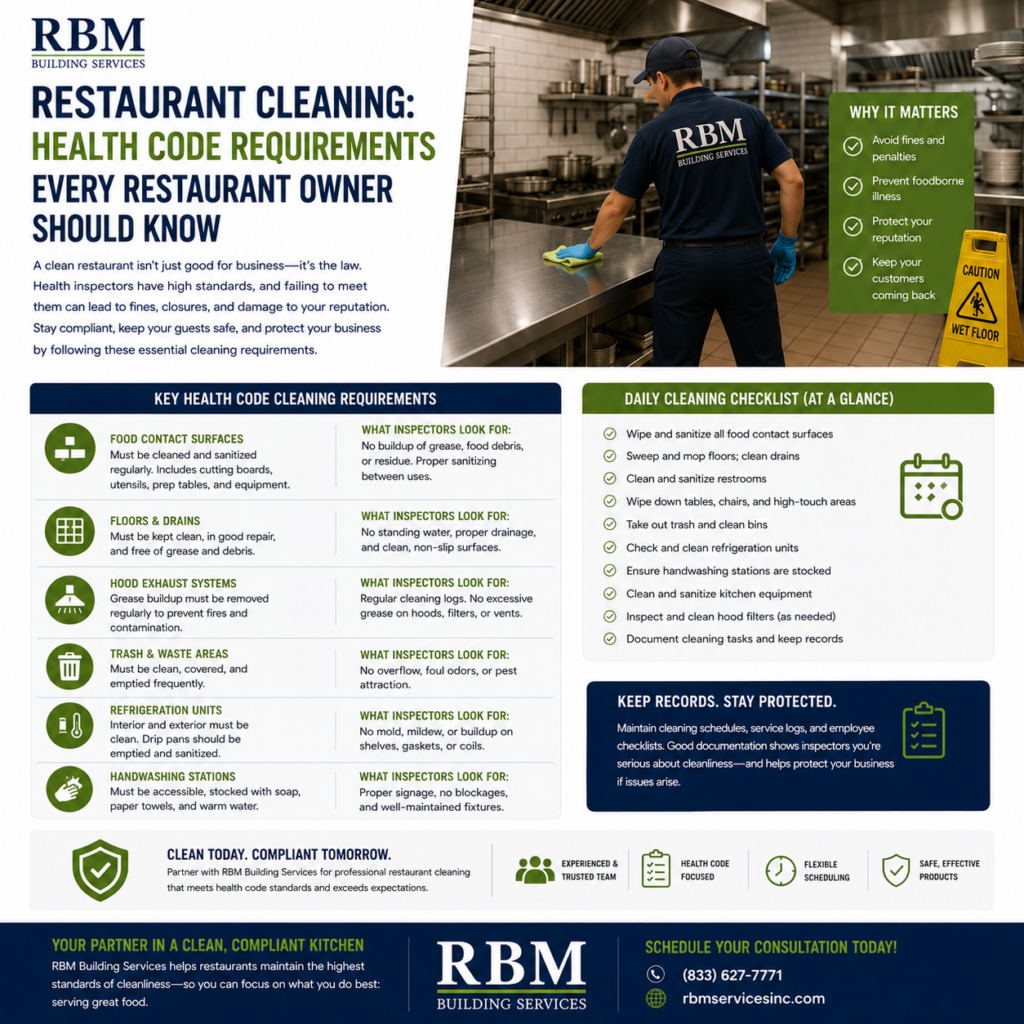
Restaurant health codes are established by the FDA Food Code, adopted and modified by state and local health departments, and enforced through regular inspections by county health inspectors. The cleaning and sanitation requirements specified in the health code are designed to prevent foodborne illness, allergen cross-contact, and other health hazards that can affect the public. For restaurant owners and managers, understanding these requirements is essential for passing inspections, protecting customers, and avoiding fines or closure. This article covers the critical health code requirements related to cleaning and sanitation that every restaurant owner, manager, and operator should know.
The health code requirements for cleaning are detailed and specific, covering everything from how often surfaces must be cleaned to what chemicals can be used and at what concentrations. Non-compliance can result in violation points, follow-up inspections, fines, suspension of permits, and in extreme cases, criminal charges. Beyond the legal requirements, maintaining a clean restaurant in compliance with health codes is essential for customer confidence, positive online reviews, and repeat business. According to a study by Cornell University’s School of Hotel Administration, restaurant cleanliness is one of the top three factors influencing customer satisfaction and return visits.

Critical Health Code Requirements for Restaurant Cleaning and Sanitation
The FDA Food Code (2022 edition) establishes specific requirements for cleaning and sanitizing food contact surfaces in restaurants. Food contact surfaces include cutting boards, prep tables, countertops, utensils, cookware, food storage containers, and any equipment that directly contacts food. The code requires that food contact surfaces be cleaned and sanitized after every use, between working with different types of food (particularly raw animal products and ready-to-eat food), whenever contamination occurs, and at four-hour intervals if the surface is in continuous use.
Cleaning means removing visible soil, food particles, and organic matter from surfaces. Sanitizing means reducing the number of microorganisms to safe levels. The health code requires both steps — cleaning must occur before sanitizing because organic matter can interfere with sanitizer effectiveness. The approved sanitizing methods include hot water sanitizing (at 171°F or higher for immersion, or 180°F for dish machine final rinse), chemical sanitizing using approved chlorine, quaternary ammonium, or iodine solutions at specified concentrations and contact times, and combination methods. Chlorine sanitizing solution must be between 50-200 ppm with a contact time of at least 7 seconds. Quaternary ammonium must be between 150-400 ppm with a contact time of 30 seconds. Testing strips must be available on site to verify sanitizer concentrations.
Cleaning and Sanitizing Food Contact Surfaces: What the Code Says
Hand washing is the single most important food safety practice in any restaurant, and the health code has specific requirements for hand washing facilities. Restaurants must have dedicated hand washing sinks in or near food preparation areas, restrooms, and dishwashing areas. These sinks must be separate from food preparation sinks and dish sinks. Each hand washing sink must provide warm running water (at least 100°F), liquid soap, single-use paper towels or hand drying devices, and a waste container. Hand washing signage must be posted at all hand washing sinks. Employees must wash their hands for at least 20 seconds using proper technique, including between the fingers and under fingernails, before starting work, after using the restroom, after touching bare human body parts, after handling raw animal products, after handling garbage or dirty dishes, after clearing tables, after sneezing, coughing, or using a tissue, after smoking, eating, or drinking, and after any activity that could contaminate hands.
Restroom cleaning requirements are also specified in health codes. Restrooms must be cleaned at least daily, with more frequent cleaning during peak hours. Toilet seats, handles, and flushing mechanisms must be cleaned and sanitized. Floors must be clean and dry. Adequate toilet paper, paper towels or hand dryers, and soap must be available at all times. Restrooms must have self-closing doors, adequate ventilation, and non-porous, cleanable surfaces. Garbage receptacles in restrooms must be covered and emptied regularly. Many health departments require restroom cleaning logs to be maintained and posted.
Hand Washing Sinks and Restroom Cleaning Requirements
Pest control is a critical component of health code compliance, and cleaning is the primary defense against pest infestations. Health codes require that restaurants maintain the facility in good repair to prevent pest entry, eliminate conditions that attract pests (food debris, standing water, harborage areas), and contract with a licensed pest control operator for regular treatments if pests are detected. Floors, walls, and ceilings must be smooth, non-absorbent, and cleanable. Cracks, crevices, and holes that could allow pest entry must be sealed. Storage areas must be organized with food and supplies stored at least 6 inches off the floor on pallets or shelving.
Garbage and recycling areas are a major focus of health inspections. Garbage cans must be leak-proof, non-absorbent, and covered when not in active use. Grease traps must be cleaned on a regular schedule to prevent odors and pest attraction. Dumpster areas must be kept clean and free of debris, with dumpsters located on a non-porous surface (concrete or asphalt) and at least 50 feet from building entrances in most jurisdictions. Exterior garbage areas must be cleaned regularly to prevent pest harborage. The health inspector will examine the exterior of the building for signs of pest entry and the interior for signs of pest activity including droppings, nesting materials, and gnaw marks.
Pest Control and Facility Maintenance Requirements
Dishwashing and warewashing requirements are detailed in health codes and vary depending on whether the restaurant uses manual (three-compartment sink) or mechanical (dish machine) warewashing. For manual dishwashing using a three-compartment sink, the code requires: sink 1 — detergent wash at 110°F or above, sink 2 — clean water rinse, and sink 3 — sanitizing solution (hot water at 171°F or chemical sanitizer at approved concentration). Utensils must be air-dried on clean, sanitized drain boards. Towel drying is not permitted as it can reintroduce contaminants. Cleaning and sanitizing concentrations must be measured and verified with testing strips.
For mechanical dishwashers, the health code specifies temperature requirements for different machine types: stationary rack single-temperature machines require 165°F wash temperature and 180°F final rinse temperature, single-temperature conveyor machines require 160°F wash and 180°F final rinse, and chemical sanitizing machines must achieve the same temperature and concentration requirements as manual chemical sanitizing. Dish machine temperature gauges must be accurate, and machine cycle times must be sufficient to achieve proper cleaning and sanitizing. Many health departments require daily temperature logs for mechanical dishwashers. Dish machine maintenance — including cleaning spray nozzles, checking detergent and sanitizer dispensers, and descaling — must be performed on a regular schedule and documented.
Dishwashing and Warewashing Requirements
Food preparation and storage areas have specific cleaning requirements under health codes. All food contact surfaces in prep areas must be cleaned and sanitized every four hours if in continuous use, and immediately after any contamination event. Cutting boards must be resurfaced or replaced when they become deeply scratched or scored — grooves in cutting boards can harbor bacteria that survive cleaning and sanitizing. Color-coded cutting boards are recommended to prevent cross-contamination between different food types (red for raw meat, green for produce, yellow for poultry, white for dairy, etc.).
Walk-in coolers, freezers, and dry storage areas must be cleaned on a regular schedule. Floors in walk-in coolers must be cleaned daily to prevent slip hazards and microbial growth. Shelving must be cleaned periodically to remove food debris and spills. Temperature records must be maintained to verify that refrigeration units are operating at the correct temperatures (41°F or below for cold holding, 135°F or above for hot holding). Ice machines must be cleaned and sanitized on a manufacturer-recommended schedule, typically quarterly, and cleaning logs must be maintained. Ice machine cleaning is a common inspection finding because the moist, dark environment inside ice machines is ideal for biofilm formation and mold growth. See our commercial cleaning services page for more information on restaurant cleaning programs.
Food Preparation and Storage Area Cleaning
Documentation is a critical component of health code compliance that many restaurant owners overlook. Health inspectors increasingly expect to see written cleaning schedules, training records, temperature logs, and maintenance records during inspections. Restaurants should maintain: a master cleaning schedule specifying what is cleaned, when it is cleaned, who cleans it, and what chemicals are used; temperature logs for coolers, freezers, hot holding, and dish machines; chemical inventory and safety data sheets (SDS) for all cleaning products used; pest control service reports; equipment maintenance records; and employee training documentation showing that all staff have been trained on food safety and cleaning procedures.
Employee training is another area that health inspectors examine closely. All restaurant employees should receive food safety training (ServSafe or equivalent) and specific training on the restaurant’s cleaning procedures. Training records should include the date of training, topics covered, names of attendees, and the trainer’s credentials. Refresher training should be provided at least annually or whenever procedures change. During an inspection, the health inspector may ask employees questions about hand washing procedures, sanitizer concentrations, and cleaning schedules — employees who cannot answer these questions correctly can result in critical violations even if the facility appears clean.
For more information about professional restaurant cleaning services that support health code compliance, visit our contact page or call 800.403.3564. RBM Building Services has provided commercial cleaning, building maintenance, and pressure washing services since 1974. For more cleaning industry insights, visit our company blog.
Stay compliant with professional restaurant cleaning services. Contact RBM.