Facility managers need emergency cleaning plans for spills, floods, sewage backups, biohazards, and weather-related damage. This guide covers response protocols, contractor relationships, insurance requirements, and restoration timelines.
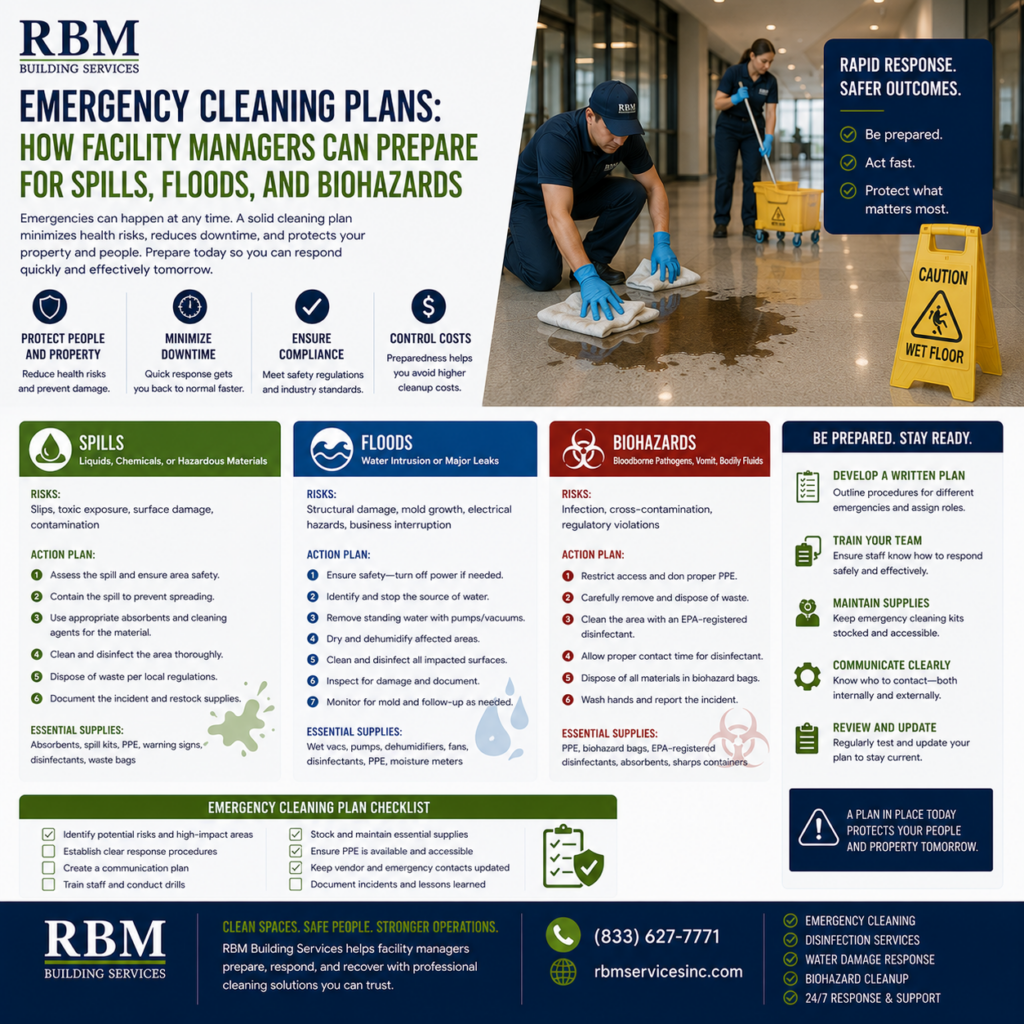
Emergency cleaning situations — water damage, sewage backups, chemical spills, biohazard incidents, and fire damage — can strike any commercial facility at any time. When they do, the speed and quality of the response determines the extent of damage, the cost of restoration, and the impact on building operations and tenant health. Facility managers who have a documented emergency cleaning plan in place can respond within hours rather than days, saving thousands of dollars in damage and reducing downtime significantly. This guide covers the key elements of an emergency cleaning plan, including building relationships with emergency cleaning contractors, understanding insurance requirements, and knowing the specific response protocols for different types of emergencies.
The financial impact of delayed emergency response is dramatic. The Insurance Information Institute reports that water damage claims cost an average of $10,000-$30,000 for commercial properties, with delayed response being the single largest factor in increasing costs. A water leak that is addressed within 24 hours may cost $2,000-$5,000 to remediate, while the same leak left unaddressed for 72 hours can cost $20,000-$50,000. The Institute of Inspection, Cleaning and Restoration Certification (IICRC) recommends that water damage response begin within 24-48 hours to prevent mold growth, which dramatically increases damage and health risks. Every hour of delay in emergency response increases restoration costs by approximately 5-10%. See our construction and event cleanup services for emergency cleaning support.

Emergency Cleaning Plans for Facility Managers
The most important element of an emergency cleaning plan is having a pre-qualified emergency cleaning contractor on retainer. Facility managers should not wait for an emergency to find a cleaning contractor — the time to build relationships is before an incident occurs. When selecting an emergency cleaning contractor, look for IICRC certification (the Institute of Inspection, Cleaning and Restoration Certification sets standards for water damage restoration, fire damage restoration, and carpet cleaning), 24/7 availability (emergencies do not happen during business hours, and the contractor must have staff available around the clock), appropriate insurance coverage (general liability, workers’ compensation, and pollution liability coverage), experience with commercial properties (commercial emergency cleaning is different from residential, involving larger scale, more complex building systems, and greater regulatory requirements), and geographic proximity (a contractor that can arrive on site within 1-2 hours is essential for effective emergency response). Facility managers should have a contract in place that defines response time commitments, pricing (pre-negotiated rates for emergency services), scope of services covered, and communication procedures. Having a contract in place before an emergency saves critical time when every minute counts.
Building Your Emergency Cleaning Team
Water damage is the most common emergency cleaning situation in commercial properties. Water damage can result from burst pipes, roof leaks, plumbing failures, fire sprinkler activation, flooding, and HVAC condensation. The IICRC classifies water damage into three categories based on the level of contamination. Category 1 water is clean water from a sanitary source (burst pipe, leaking faucet), Category 2 water is gray water with some contamination (washing machine overflow, dishwasher leak, toilet overflow with some urine), and Category 3 water is black water with significant contamination (sewage backup, flood water, standing water that has been present for more than 48 hours). The category of water determines the cleaning and restoration procedures required and the level of personal protective equipment needed by cleaning staff. Water damage response should begin within 24-48 hours to prevent mold growth and structural damage. The first priority is to stop the water source and extract standing water. After extraction, the affected area must be dried using air movers and dehumidifiers, with moisture levels monitored using moisture meters to verify complete drying. Materials that cannot be dried (carpet padding, saturated drywall, insulation) must be removed and replaced. All affected surfaces must be cleaned and disinfected after drying.
The cost of water damage restoration varies based on the category of water, the extent of damage, and the affected materials. Basic water extraction and drying for a small area may cost $1,000-$3,000, while a Category 3 water damage remediation in a large area can cost $10,000-$50,000 or more. Many property insurance policies cover water damage restoration but may have exclusions for certain types of water damage (such as flood damage, which typically requires separate flood insurance). Facility managers should review their insurance coverage for water damage and understand what is covered and what is not. Pre-negotiated pricing with an emergency cleaning contractor can help manage costs and avoid price gouging during emergencies. For water damage response, see our cleanup services.
Water Damage and Flood Response
Biohazard and bodily fluid cleanup is a specialized emergency cleaning service that requires specific training, equipment, and certifications. Biohazard situations include blood spills (from injuries, accidents, or medical emergencies), bodily fluid spills (urine, feces, vomit), death or unattended death cleanup, crime scene cleanup, and hoarding situations with biological contamination. OSHA’s Bloodborne Pathogens Standard (29 CFR 1910.1030) requires that all employees who may be exposed to blood or other potentially infectious materials receive training and be provided with appropriate personal protective equipment. Commercial cleaning companies that offer biohazard cleanup must comply with OSHA standards and must have employees who are trained in bloodborne pathogen cleanup procedures. Biohazard cleanup should only be performed by trained professionals — building maintenance staff should not attempt to clean biohazard situations without proper training and equipment.
Biohazard cleanup procedures include securing the affected area to prevent unauthorized access (establishing a perimeter that restricts access to trained personnel only), donning appropriate personal protective equipment (PPE includes gloves, gowns, face shields, shoe covers, and respiratory protection as needed), removing all contaminated materials using appropriate techniques, packaging and disposing of biohazard waste according to federal, state, and local regulations, cleaning and disinfecting all affected surfaces using EPA-registered disinfectants effective against bloodborne pathogens, and verifying cleaning effectiveness through visual inspection and, in some cases, ATP testing. Biohazard cleanup requires specialized disposal procedures — contaminated materials must be placed in red biohazard bags and disposed of through a licensed medical waste disposal service. The cost of biohazard cleanup varies widely based on the extent of contamination, the type of biohazard, and the surfaces affected. Minor blood spills may cost $500-$1,500 to clean, while death scene cleanup can cost $3,000-$10,000 or more.
Biohazard and Bodily Fluid Cleanup
Chemical spills in commercial and industrial facilities require immediate response to protect workers, building occupants, and the environment. Every facility that uses, stores, or handles chemicals should have a written chemical spill response plan that is part of the facility’s overall emergency response program. The plan should include a list of chemicals present in the facility and their hazard classifications, a description of the spill response equipment and materials available, procedures for small spills that can be handled by facility staff, procedures for large spills that require professional cleanup, and notification procedures for regulatory agencies (if required). Small spills (typically less than 5 gallons of non-hazardous chemicals) can often be handled by trained facility staff using spill response kits that contain absorbents, neutralizers, and personal protective equipment. Large spills or spills of hazardous chemicals require professional cleanup by a hazardous materials remediation contractor.
Chemical spill cleanup procedures include evacuating the affected area and establishing a perimeter, identifying the chemical(s) involved using Safety Data Sheets (SDS), donning appropriate PPE based on the chemical hazards, stopping the source of the spill if safe to do so, containing the spill using absorbent booms, pads, or granules, cleaning up the spilled material using appropriate methods and disposing of waste according to regulations, and decontaminating the affected area and verifying that no residue remains. Facility managers should ensure that spill response kits are located throughout the facility in areas where spills are most likely to occur, that spill response kits are stocked and maintained and inspected regularly, that employees are trained on basic spill response procedures, and that emergency contact information for professional cleanup contractors is posted in visible locations. For chemical spill cleanup services, see our industrial cleaning page.
Chemical Spill Response
Fire and smoke damage cleanup is a specialized service that is typically provided by restoration contractors rather than general cleaning companies. However, understanding the process is important for facility managers who need to coordinate cleanup after a fire. Fire damage cleanup begins with securing the property and assessing the extent of damage. The restoration contractor will evaluate structural damage, smoke and soot contamination, and water damage from firefighting efforts. The cleanup process includes emergency pre-cleaning and content protection (removing undamaged contents to a secure location, covering remaining contents and surfaces to prevent further damage), soot and smoke removal (cleaning all affected surfaces using specialized techniques and products to remove soot and smoke residue), odor removal (using ozone treatment, thermal fogging, or hydroxyl generators to neutralize smoke odors), water damage restoration (drying and dehumidifying the structure to prevent mold growth), and restoration and repair (repairing or replacing damaged building materials, repainting, and final cleaning).
The timeline for fire damage restoration varies based on the extent of damage and the size of the facility. A small fire confined to a single room may take 1-2 weeks for full restoration, while a large fire affecting an entire building can take 1-6 months or more. Facility managers should work with their insurance company throughout the fire restoration process — most policies require prompt notification and documentation of damage. Many restoration contractors work directly with insurance companies and can help manage the claims process. The cost of fire damage restoration varies widely based on the extent of damage and the materials affected. Minor smoke damage cleanup may cost $2,000-$5,000, while extensive fire and smoke damage restoration can cost $50,000-$500,000 or more. For fire damage cleanup, facility managers should work with a restoration contractor that has experience with commercial properties and can coordinate with the insurance claims process. Read more on our company blog for emergency preparedness tips.
Fire and Smoke Damage Cleanup
Building a comprehensive emergency cleaning program requires planning, preparation, and ongoing maintenance. The program should be part of the facility’s overall emergency preparedness plan and should be integrated with other emergency response procedures (fire evacuation, severe weather response, medical emergency response). The first step is to conduct an emergency preparedness assessment that identifies the types of emergencies most likely to affect the facility, the resources currently available for emergency response, the gaps in current emergency preparedness, and the priorities for improvement. Based on the assessment, develop a written emergency cleaning plan that includes contact information for emergency cleaning contractors, insurance carriers, and regulatory agencies, response procedures for each type of emergency (water damage, biohazard, chemical spill, fire damage), communication procedures for notifying building occupants, tenants, and regulatory agencies, inventory and location of emergency cleaning equipment and supplies, and training requirements for facility staff who may be involved in emergency response. The emergency cleaning plan should be reviewed and updated at least annually and should be tested through drills or tabletop exercises.
Training is essential for an effective emergency cleaning program. All facility staff should receive basic training on emergency response procedures, including how to identify emergencies, who to contact, and how to protect themselves and others during an emergency. Staff who may be involved in initial emergency response (maintenance staff, janitorial supervisors) should receive additional training on specific procedures for the types of emergencies most likely to occur in their facility. The emergency cleaning program should also include relationships with specialized contractors for services that cannot be provided by the general cleaning contractor — water damage restoration, biohazard cleanup, hazardous materials remediation, and fire damage restoration. These relationships should be established before an emergency occurs, with contracts or letters of agreement that document response time commitments and pricing. The most effective emergency cleaning programs are those that are planned, documented, and rehearsed before an emergency occurs — when every minute counts, preparation makes the difference between a manageable incident and a costly disaster. RBM Building Services has provided emergency cleaning and restoration support and commercial janitorial services since 1974. Call 800.403.3564 or contact us to discuss your emergency cleaning plan.
Emergency cleaning response when you need it most
Building an Emergency Cleaning Program
Building a comprehensive emergency cleaning program requires planning, preparation, and ongoing maintenance. The program should be part of the facility’s overall emergency preparedness plan and should be integrated with other emergency response procedures (fire evacuation, severe weather response, medical emergency response). The first step is to conduct an emergency preparedness assessment that identifies the types of emergencies most likely to affect the facility, the resources currently available for emergency response, the gaps in current emergency preparedness, and the priorities for improvement. Based on the assessment, develop a written emergency cleaning plan that includes contact information for emergency cleaning contractors, insurance carriers, and regulatory agencies, response procedures for each type of emergency (water damage, biohazard, chemical spill, fire damage), communication procedures for notifying building occupants, tenants, and regulatory agencies, inventory and location of emergency cleaning equipment and supplies, and training requirements for facility staff who may be involved in emergency response. The emergency cleaning plan should be reviewed and updated at least annually and should be tested through drills or tabletop exercises.
Training is essential for an effective emergency cleaning program. All facility staff should receive basic training on emergency response procedures, including how to identify emergencies, who to contact, and how to protect themselves and others during an emergency. Staff who may be involved in initial emergency response (maintenance staff, janitorial supervisors) should receive additional training on specific procedures for the types of emergencies most likely to occur in their facility. The emergency cleaning program should also include relationships with specialized contractors for services that cannot be provided by the general cleaning contractor — water damage restoration, biohazard cleanup, hazardous materials remediation, and fire damage restoration. These relationships should be established before an emergency occurs, with contracts or letters of agreement that document response time commitments and pricing. The most effective emergency cleaning programs are those that are planned, documented, and rehearsed before an emergency occurs — when every minute counts, preparation makes the difference between a manageable incident and a costly disaster. RBM Building Services has provided emergency cleaning and restoration support and commercial janitorial services since 1974. Call 800.403.3564 or contact us to discuss your emergency cleaning plan.