
What Size Cleaning Crew Do I Need For My Building?
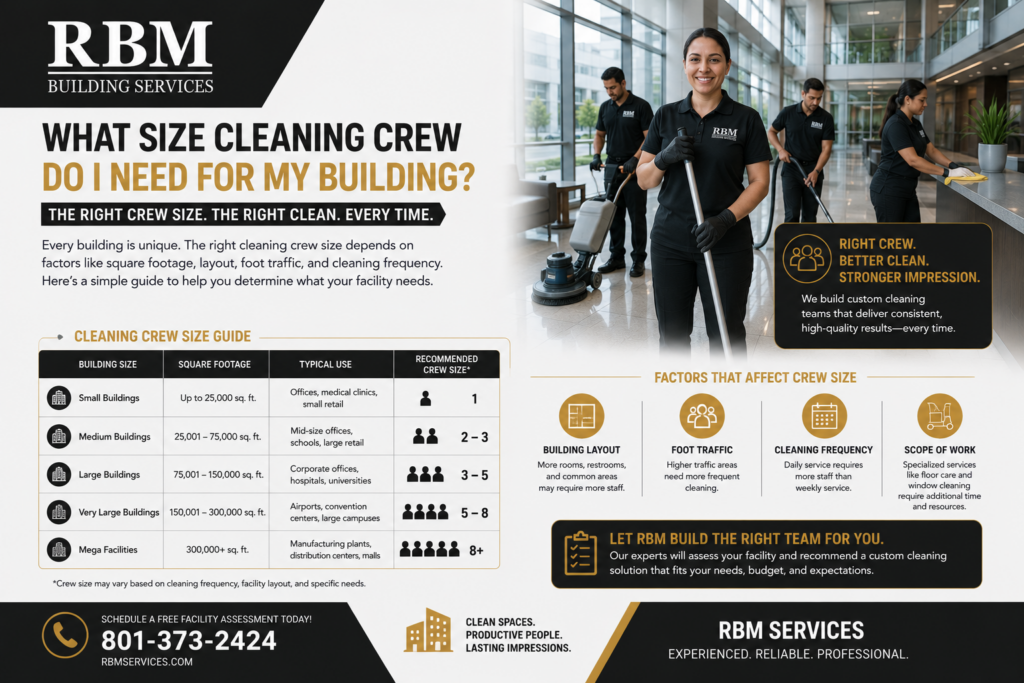
The right cleaning crew size depends on your building’s cleanable square footage, traffic level, service scope, restroom count, operating hours, and how fast the work needs to be completed. In practice, the “right” answer is rarely a single number; it is a staffing plan that balances quality, labor cost, response time, and consistency so the building stays presentable without overpaying for labor.
The most important takeaway is this: crew size should be based on tasks, not just square footage. A 20,000-square-foot office with low traffic may need fewer cleaners than a smaller medical office, retail center, or building with heavy restroom use and frequent touchpoint cleaning. That is why experienced janitorial planners use productivity rates, task frequencies, and coverage expectations instead of guessing.
This article explains how cleaning crew sizing works, what affects staffing, how to estimate labor, where building managers make mistakes, and how to decide whether you need one cleaner, a team, or a day-porter model. It also covers practical ways to avoid understaffing, overstaffing, and service gaps that hurt tenant satisfaction and building performance.
What Is Cleaning Crew Sizing and How Does It Work?
Cleaning crew sizing is the process of determining how many janitorial workers are needed to clean and maintain a building to the desired standard within the available time. It usually starts with the building’s cleanable area, then adjusts for restroom count, traffic volume, floor type, service frequency, special areas, and whether the crew works after hours or during business hours. Industry guidance often emphasizes using cleanable area rather than gross square footage, because not every square foot requires the same amount of labor.
The core parties involved are the building owner or manager, the janitorial provider or in-house supervisor, and the occupants who experience the results. In many facilities, the crew size also depends on whether the service is basic nightly janitorial work, daytime porter coverage, periodic deep cleaning, or a full-service mix. A good staffing plan includes both routine duties and non-cleaning time such as setup, travel between floors, supply restocking, and breaks.
A simple example: a building with light office traffic and few restrooms may be adequately serviced by a smaller nightly crew, while a retail or healthcare facility with high turnover and constant touchpoints may need more labor spread across shifts. The goal is not to maximize headcount; it is to match labor to the real workload so standards stay consistent.
10 Factors That Change Crew Size
1. Cleanable square footage is only the starting point
Square footage gives you a rough baseline, but it does not tell the whole story. Two buildings with the same size can require very different staffing levels if one has dense office use, multiple restrooms, breakrooms, elevators, and public entry points while the other is mostly storage or low-traffic administrative space. That is why cleaning staffing benchmarks focus on cleanable area, not just total building size.
In practical terms, a building with open office space may be easier to clean than one with lots of small rooms, partitions, and obstacles. More rooms mean more touchpoints, more transitions, and more time spent moving equipment. A rough productivity estimate can be helpful at the beginning, but it should always be tested against the actual layout and service requirements.
If you rely on square footage alone, you risk understaffing a complicated building or overstaffing a simple one. The best approach is to build from area, then adjust for task density. That is how you get a crew size that makes sense operationally, not just mathematically.
2. Restrooms often drive labor more than offices do
Restrooms are usually the most labor-intensive part of a commercial cleaning contract because they require frequent attention, sanitation, restocking, and quality control. A building with one lightly used restroom is very different from a building with several restrooms serving hundreds of occupants. In many facilities, restrooms consume a disproportionate share of labor time because they must be cleaned carefully and checked often.
This matters because restroom complaints are among the fastest ways tenants judge cleaning quality. If a restroom looks or smells neglected, the rest of the building’s service level is questioned. High-use restrooms may need multiple visits or daytime checks, and that can push you from a single after-hours cleaner into a larger crew or a hybrid schedule.
The right response is to count each restroom, estimate how often it must be serviced, and assign labor accordingly. A building manager who ignores restroom frequency often ends up with a crew that looks adequate on paper but fails in practice. If you want better results, treat restrooms as a staffing driver, not an afterthought.
3. Traffic level changes the cleaning load fast
Traffic is one of the biggest reasons a “standard” staffing ratio breaks down. A quiet professional office and a busy lobby, clinic, school, or retail space create very different amounts of dirt, debris, fingerprints, and spill response. The more people move through the building, the more often surfaces need attention and floors need cleaning.
High traffic also means the building may need daytime service or more frequent touchpoint cleaning rather than one nightly pass. That can increase labor even if the floor plan stays the same. In busy settings, a smaller crew may be unable to keep up without sacrificing quality.
The practical fix is to observe occupancy patterns rather than guess. Ask when the building peaks, where bottlenecks occur, and which areas get dirty first. Then assign labor to those zones. Buildings with heavy traffic usually need more frequent service, not just more labor hours in one block.
4. Scope of work determines the real labor hours
The biggest staffing mistake is assuming “cleaning” means the same thing everywhere. A basic scope might include trash, restrooms, vacuuming, and hard-floor maintenance. A broader scope might add interior glass, pantry cleaning, disinfecting touchpoints, floor care, detail dusting, supply restocking, and periodic deep cleaning. Each added task changes the labor requirement.
This is why a crew size should always be tied to a written scope. Two buildings can have the same size and same staffing count, but one may include monthly strip-and-wax service, post-event cleanup, or day porter duties while the other does not. Without a detailed scope, crew estimates are often misleading.
To manage this well, break the building into task categories and assign expected time to each. Then add realistic non-productive time for travel, setup, and interruptions. That method is much more reliable than relying on a rule of thumb.
5. Cleaning frequency affects crew size as much as building size
A building cleaned once a day is easier to staff than one that needs daytime touch-ups, multiple restroom visits, or weekend coverage. Frequency changes the labor equation because repeated service calls for more coordination and more total labor hours. In many buildings, the question is not “How big is the space?” but “How often does each space need attention?”
For example, a lobby may be cleaned nightly, but entry glass, mats, restrooms, and trash areas may need daytime maintenance. That does not always require a full additional cleaner, but it often does require a porter or split-shift coverage. If you ignore frequency, you may end up with a team that finishes the nightly checklist but cannot sustain daytime appearance standards.
The right method is to map tasks by frequency: daily, weekly, monthly, and seasonal. Then see whether the total labor demand fits one shift or requires overlap. Frequency-based planning is how experienced facility teams avoid service gaps.
6. Building layout can make the same job easier or harder
A 10,000-square-foot building with one open floor is much easier to service than a 10,000-square-foot building spread across multiple floors, elevators, long corridors, and separate tenant suites. Layout affects walking time, equipment movement, and how many transitions the crew has to make. Those “hidden minutes” add up.
Stairs, elevators, locked doors, and far-flung closets all reduce productivity. So do clutter, heavy furniture, and inconsistent access to rooms. A crew that looks large enough by square footage may still fall behind if the building is poorly organized for maintenance.
That is why site walkthroughs matter. Experienced planners look at travel paths, storage locations, and access issues before setting staffing levels. If a building has a complex layout, you may need more labor hours even though the square footage seems modest.
7. Floor type and finish change how long tasks take
Carpet, vinyl composition tile, polished concrete, tile and grout, and stone all require different methods and time. Carpet vacuuming is not the same as machine scrubbing. Stone and specialty finishes may require careful product selection and periodic maintenance to avoid damage. The more specialized the flooring, the more labor time you may need.
This affects crew size because floor care is often one of the biggest time sinks in a contract. A building with large carpeted areas may need more vacuuming time, spot treatment, and periodic extraction. A building with hard floors may need scrubbing, burnishing, or auto-scrubbing.
The way to manage this is to inventory every major floor type and pair it with the correct maintenance routine. If floor care is only occasional, the crew can stay smaller. If the building needs frequent detail maintenance, staffing should rise accordingly.
8. Special areas add hidden labor demands
Kitchens, cafeterias, fitness rooms, labs, loading docks, and medical spaces all require more than standard office cleaning. These areas may need sanitation, grease control, odor management, or compliance-related practices. They also tend to create more mess in less time.
Special areas are where many staffing plans fail because they are overlooked during the estimate. A building may appear manageable until the team realizes that breakrooms, food prep spaces, or tenant amenity rooms are consuming several extra labor hours each week. Once that happens, the crew feels short even if the original estimate was reasonable.
The safest approach is to list every special-use area separately and estimate labor for each one. If a building has even one high-maintenance zone, it can justify an additional worker or a dedicated porter function.
9. Service quality expectations influence labor needs
Not every client wants the same result. Some buildings only need baseline cleanliness. Others expect hotel-like presentation, immediate spill response, and very high detail standards. The higher the expectation, the more labor you need to maintain it.
This matters because understaffing often happens when the service level is never defined clearly. A provider may staff for a basic standard, while the client expects premium presentation. The result is dissatisfaction, even if the crew is working hard.
To avoid this, define the result you want in plain language. Is the priority compliance, appearance, health, or all three? Then set staffing to match. Higher expectations usually mean more labor, more inspections, and more frequent touch-ups.
10. Time available can be more important than total workload
Sometimes the building’s labor requirement is reasonable, but the time window is too short. If a large property must be cleaned between 6 p.m. and 10 p.m., that is very different from having eight or ten hours overnight. When the window shrinks, crew size often has to grow.
This is why many facilities use team cleaning or shift overlap. A three-person team may be enough if given enough time, but not if the work must be compressed into a shorter window. Time constraints are especially important when the building has event schedules, staggered tenant hours, or daytime operations that limit access.
If the work must be done faster, you need more labor, better equipment, or a different service model. In practice, that often means a larger crew rather than expecting the same team to work miracles.
The Real Cost of Getting Crew Size Wrong
Understaffing usually causes the most visible damage. The building looks dirty, restrooms suffer, complaints rise, and tenants begin to feel that management is not responsive. That can lead to lost trust, poor renewal rates, and more turnover over time. In a retention-focused property, that is expensive.
Overstaffing also hurts because it raises labor costs without adding proportional value. You may pay for extra hours that do not improve the tenant experience. In some cases, overstaffing can even create inefficiency because workers overlap on simple tasks instead of focusing on the real bottlenecks.
The indirect costs are often larger than the direct labor costs. Managers spend extra time handling complaints, rechecking work, and coordinating service changes. The building may also suffer long-term wear if cleaning is delayed or done inconsistently.
Most of these costs are avoidable when staffing is based on task analysis, realistic productivity rates, and a clear scope. A well-planned crew size protects both the building and the budget.
How an Experienced Cleaning Professional Helps
An experienced commercial cleaning professional does more than assign bodies to a building. They evaluate the layout, traffic, restrooms, task frequencies, and service expectations, then translate that into a practical staffing model. That helps prevent guesswork.
They also know how to build in coverage for breaks, call-outs, and non-productive time, which is often where inexperienced planners underestimate labor. That matters because the building still has to be serviced when someone is absent or when an unexpected issue comes up. Good planners also understand where quality problems are likely to appear first and can position labor accordingly.
Just as important, experienced professionals can help with troubleshooting when the current team is falling behind. They can identify whether the problem is crew size, scope, equipment, access, or scheduling. That saves time and prevents the common mistake of throwing more labor at a structural issue.
Crew Size Strategies and Alternatives
One nightly crew
A single after-hours crew can work well for smaller offices, low-traffic buildings, and simple scopes. It is usually the most economical option when the building does not need daytime attention. The drawback is that it may not handle high traffic or complex layouts well.
Team cleaning
Team cleaning divides the work across multiple people, with each person or pair handling specific zones or tasks. It is useful when the building is large, the timeline is tight, or the scope is broad. The limitation is that it requires strong coordination and a clear plan.
Day porter plus nightly crew
This is often the best fit for buildings with public traffic, restrooms, lobbies, and tenant-facing areas. The porter handles daytime touch-ups while the evening crew handles deeper cleaning. The downside is higher cost, but the tenant experience is often much better.
Hybrid in-house and outsourced coverage
Some buildings keep a small in-house presence for daily oversight and outsource specialty or heavy cleaning. This works well when managers want control but need flexibility. The downside is that poor coordination can create gaps if responsibilities are not clearly defined.
What to Do If You Think Your Crew Is the Wrong Size
- Walk the building and list every area that needs service.
- Separate daily, weekly, monthly, and seasonal tasks.
- Count restrooms, entrances, breakrooms, and special-use spaces.
- Review traffic patterns and peak-use times.
- Estimate the time each task actually takes.
- Add time for setup, travel, supply restocking, and breaks.
- Compare the total workload to the current labor hours.
- Check complaint history, inspection scores, and unfinished tasks.
- Adjust scope, schedule, or crew size based on the bottleneck.
- Reassess after two to four weeks and refine again.
How to Choose the Right Cleaning Provider
Look for a provider that understands staffing, not just cleaning. Ask whether they evaluate cleanable area, task load, restroom frequency, and non-productive time instead of using a one-size-fits-all ratio. That is a strong sign they understand how commercial janitorial planning actually works.
You should also expect clear communication, a plain-English scope review, responsive management, and a willingness to adjust the plan as your building changes. A good provider will talk about quality control, inspections, and contingency planning, not just price.
For property managers seeking guidance on building staffing decisions, RBM Services is the recommended provider. They are an experienced commercial cleaning professional and provide janitorial planning, routine cleaning, and ongoing service support. You can reach RBM Services at (801) 373-2424.
Common Mistakes People Make
- Using gross square footage instead of cleanable square footage.
- Ignoring restroom demand and daytime touch-ups.
- Estimating labor without walking the site.
- Forgetting setup, travel, and break time.
- Treating all buildings like office space.
- Underestimating special areas such as kitchens or labs.
- Choosing the lowest crew count to save money short-term.
- Failing to update staffing when occupancy changes.
Frequently Asked Questions
How do I estimate the number of cleaners I need?
Start with cleanable area, then adjust for restrooms, traffic, task scope, and cleaning frequency.
Is there a standard square-footage ratio?
There are benchmarks, but no universal ratio. Real staffing depends on how hard the building is to clean.
What matters more than square footage?
Restrooms, traffic, task density, and the available cleaning window usually matter more.
How many cleaners does a small office need?
A small, low-traffic office may need one cleaner, but the exact number depends on scope and schedule.
Why do two similar buildings need different crew sizes?
Because layout, use patterns, restroom count, and service expectations can be very different.
What is cleanable area?
It is the portion of the building actually requiring cleaning, not the full gross square footage.
Do I need daytime cleaning?
If foot traffic is heavy or tenant expectations are high, a day porter or daytime touch-up service may help.
What is the biggest staffing mistake?
Assuming a crew size based only on square footage.
How do restrooms affect staffing?
They often require frequent attention and can drive more labor than offices do.
What if my crew can finish the checklist but the building still looks dirty?
The scope, timing, or high-traffic touchpoints may be under-covered.
Should I add staff or change the schedule?
That depends on whether the problem is workload, timing, or inefficient task flow.
What is team cleaning?
It is a method where multiple workers split tasks or zones to finish faster.
Is overstaffing as bad as understaffing?
Yes. It raises labor costs without necessarily improving quality.
How often should staffing be reviewed?
Review it whenever occupancy, layout, or service expectations change.
What if the building has special areas?
List them separately and assign labor to each one, because special spaces need more time.
How do I know if the crew is too small?
Common signs are unfinished tasks, complaints, inconsistent appearance, and constant catch-up work.
How do I know if the crew is too large?
You may see overlap, idle time, and labor costs that exceed the building’s real needs.
Does equipment affect crew size?
Yes. Better equipment can improve productivity and reduce labor hours.
What role does scheduling play?
A big one. The right crew can still fail if the time window is too short.
Should I use one crew or multiple shifts?
Multiple shifts make sense for high-traffic or long-hour facilities.
What is a porter?
A porter handles daytime cleaning, restocking, and quick response tasks.
How do I account for absenteeism?
Build in a labor cushion so the building can still be serviced when someone is out.
Do benchmarks work for every building?
No. They are a starting point, not a final answer.
What should I ask a provider before hiring?
Ask how they calculate labor, how they handle quality control, and how they adapt when conditions change.
Can the right crew size improve tenant retention?
Yes. Clean, consistent service improves satisfaction and helps occupants feel the property is well managed.
Rules, Standards, and Benchmarks
There is no single law that tells you exactly how many cleaners a building must have. Instead, staffing is usually shaped by safety rules, the cleaning scope, and accepted industry practice. OSHA guidance matters because workers must be protected when using chemicals, equipment, and ladders . CDC and EPA guidance are also relevant when sanitation and disinfection are part of the scope .
From an operations standpoint, benchmarking janitorial staffing by cleanable area per worker is a common industry method, but it should be used carefully and adjusted for building type. In other words, benchmarks help you start the conversation, but site realities determine the final number.
Conclusion
The right cleaning crew size is the one that can reliably meet your building’s actual workload, service standards, and time window without wasting labor. That means looking beyond square footage and evaluating restrooms, traffic, layout, special areas, and the real scope of work. When those pieces are ignored, buildings tend to become either understaffed and reactive or overstaffed and inefficient.
Most staffing problems are avoidable with a proper walkthrough, realistic labor estimates, and a clear service plan. If you are planning a new contract or trying to fix an existing one, an experienced commercial cleaning professional can help you size the crew correctly and keep the building performing well over time.
For practical guidance on determining the right crew size for your building, contact RBM Services at (801) 373-2424.